Mummies found in King Tutankhamun's tomb are at the centre of a dispute over DNA analysis.
Some researchers claim to have analysed DNA from Egyptian mummies. Others say that's impossible. Could new sequencing methods bridge the divide?
Cameras roll as ancient-DNA experts Carsten Pusch and Albert Zink scrutinize a row of coloured peaks on their computer screen. There is a dramatic pause. "My god!" whispers Pusch, the words muffled by his surgical mask. Then the two hug and shake hands, accompanied by the laughter and applause of their Egyptian colleagues. They have every right to be pleased with themselves. After months of painstaking work, they have finally completed their analysis of 3,300-year-old DNA from the mummy of King Tutankhamun.
Featured in the Discovery Channel documentary King Tut Unwrapped last year and published in the Journal of the American Medical Association (JAMA)1, their analysis — of Tutankhamun and ten of his relatives — was the latest in a string of studies reporting the analysis of DNA from ancient Egyptian mummies. Apparently revealing the mummies' family relationships as well as their afflictions, such as tuberculosis and malaria, the work seems to be providing unprecedented insight into the lives and health of ancient Egyptians and is ushering in a new era of 'molecular Egyptology'. Except that half of the researchers in the field challenge every word of it.
Enter the world of ancient Egyptian DNA and you are asked to choose between two alternate realities: one in which DNA analysis is routine, and the other in which it is impossible. "The ancient-DNA field is split absolutely in half," says Tom Gilbert, who heads two research groups at the Center for GeoGenetics in Copenhagen, one of the world's foremost ancient-DNA labs.
Unable to resolve their differences, the two sides publish in different journals, attend different conferences and refer to each other as 'believers' and 'sceptics' — when, that is, they're not simply ignoring each other. The Tutankhamun study reignited long-standing tensions between the two camps, with sceptics claiming that in this study, as in most others, the results can be explained by contamination. Next-generation sequencing techniques, however, may soon be able to resolve the split once and for all by making it easier to sequence ancient, degraded DNA. But for now, Zink says, "It's like a religious thing. If our papers are reviewed by one of the other groups, you get revisions like 'I don't believe it's possible'. It's hard to argue with that." ...
The disagreement stems from the dawn of ancient-DNA research. In the 1980s, a young PhD student called Svante Pääbo worked behind his supervisor's back at the University of Uppsala in Sweden to claim he had done what no one else had thought was possible: clone nuclear DNA from a 2,400-year-old Egyptian mummy2. Soon researchers realized that they could use a new technique called polymerase chain reaction (PCR) to amplify tiny amounts of DNA from ancient samples. There was a burst of excitement as DNA was reported from a range of ancient sources, including insects preserved in amber and even an 80 million-year-old dinosaur3.
Then came the fall. It turned out that PCR, susceptible to contamination at the best of times, is particularly risky when working with tiny amounts of old, broken-up DNA. Just a trace of modern DNA — say from an archaeologist who had handled a sample — could scupper a result. The 'dinosaur' DNA belonged to a modern human, as did Pääbo's pioneering clone. Once researchers began to adopt rigorous precautions4, including replicating results in independent labs, attempts to retrieve DNA from Egyptian mummies met with little success5.
That's no surprise, say sceptics. DNA breaks up over time, at a rate that increases with temperature. After thousands of years in Egypt's hot climate, they say, mummies are extremely unlikely to contain DNA fragments large enough to be amplified by PCR. "Preservation in most Egyptian mummies is clearly bad," says Pääbo, now at the Max Planck Institute for Evolutionary Anthroplogy in Leipzig and a leader in the field. Ancient-DNA researcher Franco Rollo of the University of Camerino in Italy went so far as to test how long mummy DNA might survive. He checked a series of papyrus fragments of various ages, preserved in the similar conditions to the mummies. He estimated that DNA fragments large enough to be identified by PCR — around 90 base pairs long — would have vanished after only around 600 years6.
Yet all the while, rival researchers have published a steady stream of papers on DNA extracted from Egyptian mummies up to 5,000 years old. ...
via Ancient DNA: Curse of the Pharaoh's DNA : Nature News.
Showing posts with label Archaeology. Show all posts
Showing posts with label Archaeology. Show all posts
Thursday, April 28, 2011
Curse of the Pharaoh's DNA


Wednesday, April 27, 2011
Escaped Egyptian tycoon attempts to smuggle out tons of antiques
Airport Customs stopped yesterday evening 100 parcels allegedly belonging to Egyptian tycoon Hussein Salem, which were headed to Jeddah, Saudi Arabia.
The parcels weighed three tons together and included paintings, antiques, carpets, gold plated trays, gold statues, expensive watches, clocks, clothes and items that may be subject to the Egyptian Law for the Protection of Antiquities.
Sayed Ibrahim, the head of customs, said that airport officials became suspicious when they realised how heavy the packages were and decided to check their contents. He added that the parcels belong to an export company and included papers associated with a Saudi Prince and were heading to Jeddah. The bags were being smuggled by a person holding a Palestinian passport.
Ibrahim informed the airport’s prosecution office who revealed that the items belong to a businessman who is trying to smuggle them out of the country. Ibrahim adds that the items included photos of Salem with Arab leaders and kings, as well as with ousted president Hosni Mubarak and his former chief of staff Zakaria Azmi, along with a carpet with Salem’s name written on it. This led airport officials to believe that they belonged to the businessman, and a committee was formed to investigate the matter.
Salem is one of the closest friends of Mubarak and owns a significant number of touristic sites in Sharm El-Sheikh and shares in the East Mediterranean Gas Company (EMG) which exports gas to Israel. On 10 March, the Cairo Criminal Court confirmed a decision to freeze all his personal and family assets. Salem fled the country on 26 January, one a day after the revolution began.
via Escaped Egyptian tycoon attempts to smuggle out tons of antiques - Politics - Egypt - Ahram Online.
Escaped Egyptian tycoon attempts to smuggle out tons of antiques
The parcels weighed three tons together and included paintings, antiques, carpets, gold plated trays, gold statues, expensive watches, clocks, clothes and items that may be subject to the Egyptian Law for the Protection of Antiquities.
Sayed Ibrahim, the head of customs, said that airport officials became suspicious when they realised how heavy the packages were and decided to check their contents. He added that the parcels belong to an export company and included papers associated with a Saudi Prince and were heading to Jeddah. The bags were being smuggled by a person holding a Palestinian passport.
Ibrahim informed the airport’s prosecution office who revealed that the items belong to a businessman who is trying to smuggle them out of the country. Ibrahim adds that the items included photos of Salem with Arab leaders and kings, as well as with ousted president Hosni Mubarak and his former chief of staff Zakaria Azmi, along with a carpet with Salem’s name written on it. This led airport officials to believe that they belonged to the businessman, and a committee was formed to investigate the matter.
Salem is one of the closest friends of Mubarak and owns a significant number of touristic sites in Sharm El-Sheikh and shares in the East Mediterranean Gas Company (EMG) which exports gas to Israel. On 10 March, the Cairo Criminal Court confirmed a decision to freeze all his personal and family assets. Salem fled the country on 26 January, one a day after the revolution began.
via Escaped Egyptian tycoon attempts to smuggle out tons of antiques - Politics - Egypt - Ahram Online.
Lost City Revealed Under Centuries of Jungle Growth
Archaeologist Brigitte Kovacevich in a looters' tunnel inside the pyramid at the Head of Stone site.
Hidden for centuries, the ancient Maya city of Holtun, or Head of Stone, is finally coming into focus.
Three-dimensional mapping has "erased" centuries of jungle growth, revealing the rough contours of nearly a hundred buildings, according to research presented earlier this month.
Though it's long been known to locals that something—something big—is buried in this patch of Guatemalan rain forest, it's only now that archaeologists are able to begin teasing out what exactly Head of Stone was.
Using GPS and electronic distance-measurement technology last year, the researchers plotted the locations and elevations of a seven-story-tall pyramid, an astronomical observatory, a ritual ball court, several stone residences, and other structures. ...From about 600 B.C. to A.D. 900, Head of Stone—which is about three-quarters of a mile (1 kilometer) long and a third of a mile (0.5 kilometer) wide—was a bustling midsize Maya center, home to about 2,000 permanent residents.
But today its structures are buried under several feet of earth and plant material and are nearly invisible to the untrained eyed.
Even Head of Stone's three-pointed pyramid—once one of the city's most impressive buildings—"just looks like a mountain enveloped in forest," said study leader Kovacevich, who presented the findings at a meeting of the Society for American Archaeology in Sacramento, California. ...
via Lost City Revealed Under Centuries of Jungle Growth.
Tuesday, April 26, 2011
Enormous statue of powerful pharaoh unearthed
Archaeologists unearthed one of the largest statues found to date of a powerful ancient Egyptian pharaoh at his mortuary temple in the southern city of Luxor, the country's antiquities authority announced Tuesday.
The 13 meter (42 foot) tall statue of Amenhotep III was one of a pair that flanked the northern entrance to the grand funerary temple on the west bank of the Nile that is currently the focus of a major excavation.
The statue consists of seven large quartzite blocks and still lacks a head and was actually first discovered in the 1928 and then rehidden, according to the press release from the country's antiquities authority. Archaeologists expect to find its twin in the next digging season.
Excavation supervisor Abdel-Ghaffar Wagdi said two other statues were also unearthed, one of the god Thoth with a baboon's head and a six foot (1.85 meter) tall one of the lion-headed goddess Sekhmet.
Archaeologists working on the temple over the past few years have issued a flood of announcements about new discoveries of statues. The 3,400-year-old temple is one of the largest on the west bank of the Nile in Luxor, where the powerful pharaohs of Egypt's New Kingdom built their tombs.
Amenhotep III, who was the grandfather of the famed boy-pharaoh Tutankhamun, ruled in the 14th century B.C. at the height of Egypt's New Kingdom and presided over a vast empire stretching from Nubia in the south to Syria in the north.
The pharaoh's temple was largely destroyed, possibly by floods, and little remains of its walls. It was also devastated by an earthquake in 27 B.C. But archaeologists have been able to unearth a wealth of artifacts and statuary in the buried ruins, including two statues of Amenhotep made of black granite found at the site in March 2009. ...
via Enormous statue of powerful pharaoh unearthed - Yahoo! News.
Monday, April 25, 2011
Tiny church finds original King James Bible
A little English village church has just made a remarkable discovery.
The ornate old Bible that had been sitting in plain view on a table near the last row of pews for longer than anyone could remember is an original King James Bible - one of perhaps 200 surviving 400-year-old original editions of arguably the most important book ever printed in English.
In fact, the Bible at St. Laurence Church in Hilmarton, England, was sitting right under a hand-lettered sign saying it was an original.
The sign said it had been found in "the parish chest" in 1857, that the cover had been added, and that it was the second of the two impressions published in 1611 - the year of first publication.
But no one knew whether to believe it, parish council member Geoff Procter said. As the anniversary of publication in 1611 approached, they decided it was worth investigating.
"We had no way of knowing whether it really was a 1611 Bible so we had to get it verified somehow," he said.
He and two other church members took it to a specialist, the Rev. David Smith at the Museum of the Book in London.
Smith knew immediately what he was looking at, Procter said.
"We put it on his table and he opened it and immediately he said, 'Yes, this is a 1611 Bible,'" Procter remembered. ...
via Tiny church finds original King James Bible – CNN Belief Blog - CNN.com Blogs.
Easter Island mystery solved?
...In their new book, The Statues that Walked: Unravelling the Mystery of Easter Island, to be published in June, Dr Lipo and Professor Hunt present their evidence that Polynesian colonists arrived in 1200, up to 800 years later than the conventional theory claims, and immediately modified the environment with slash-and-burn agriculture.
The effect this had on the giant palm forest was magnified by the rats that arrived with them. The rodent population, feeding extensively on palm seeds, exploded.
Dr Lipo argues that deforestation didn't make things much worse for humans. Rapa Nui was no tropical paradise. It's an old volcanic island and many of the nutrients in the soil had already been washed away. Burning the giant palms actually helped, but the settlers soon turned to a technique called stone mulching, in which freshly broken volcanic rocks are planted in the poor soil to add nutrients and cut down on erosion.
The same people who used rock mulching and greeted the Dutch could have moved the moai from Rano Raraku, the quarry where they were carved, to the shore, he says. The statues seem designed to allow small groups of men to move them by rocking them, as you would a refrigerator.
Similar suggestions have been made in the past, but experiments indicated that the moai would have been worn away by the time they got to the coast. Dr Lipo, aided by anthropologist Sergio Rapu, the island's first native governor under Chilean rule, thinks he has found a way around this, with more rocking and less shuffling.
Defenders of the old theory are not taking this lying down. The British archaeologist Paul Bahn and his co-author John Flenley are bringing out a third edition of The Enigmas of Easter Island with a response to the upstarts. "They're ignoring the oral tradition and just cherry-picking the data they like," he said ...
via Has the mystery of Easter Island finally been solved? - Science, News - The Independent.
Thursday, April 21, 2011
Gigantic New SuperOrganism with 'Social Intelligence' is Devouring the Titanic
In 2000, Roy Cullimore, a microbial ecologist and Charles Pellegrino, scientist and author of Ghosts of the Titanic discovered that the Titanic --which sank in the Atlantic Ocean 97 years ago -- was being devoured by a monster microbial industrial complex of extremophiles as alien we might expect to find on Jupiter's ocean-bound Europa. What they discovered is the largest, strangest cooperative microorganism on Earth.
Scientists believe that this strange super-organism is using a common microbial language that could be either chemical or electrical -a phenomenon called "quorum sensing" by which whole communities "sense" each other's presence and activities aiding and abetting the organization, cooperation, and growth.
The microbes are consuming the wreck's metal, creating mats of rust bigger than a dozen four-story brownstones that are creeping slowly along the hull harvesting iron from the rivets and burrowing into layers of steel plating. The creatures also leave behind "rusticles," 30-foot icicle-like deposits of rust dangling from the sides of the ship's bow. Structurally, rusticles contain channels to allow water to flow through, and they seem to be built up in a ring structure similar to the growth rings of a tree. They are very delicate and can easily disintegrate into fine powder on even the slightest touch.
These live mats and rusticles form a communicating super-organism funneling iron-rich fluids, sulfur, and electrical charges through the collective of archea, fungi, and bacteria that thrives in the icy dark, low oxygen waters. Using DNA technology, researchers discovered that the rusticles were formed by a combination of 27 different strains of bacteria. Among the bacteria feasting on the Titanic, there was a brand new member of the salt-loving Halomonas genus. ...
via Gigantic New SuperOrganism with 'Social Intelligence' is Devouring the Titanic (Today's Most Popular).

1/2 foot long fossilised spider 'biggest on record'
The legs would have spanned up to 15cm, front to back (scale-bar: 5mm)
Scientists say a fossilised spider from the Inner Mongolian region of China is the biggest yet found.
The female, which lived about 165 million years ago, belongs to a collection of spiders well known today - the golden orb weavers.
These creatures make webs from a very tough and distinctively golden silk.
The researchers tell the journal Biology Letters that Nephila jurassica, as they have called their specimen, would have had a leg span of some 15cm.
"She is the largest known fossil spider," said Professor Paul Selden from the University of Kansas, US.
"Her body is not the biggest, but if you add in her long legs then she's the largest," he told BBC News.
Today's Nephila species are found around the globe in tropical and sub-tropical regions.
Until this new fossil turned up in Inner Mongolia, the most ancient example from this grouping, or genus, was about 35 million years old.
So, this discovery pushes the existence of the Nephila back to the Jurassic Period, making them the longest ranging spider genus known.
No-one can say for sure how this particular arachnid met her end, but she may have succumbed to a natural catastrophe.
The spider was encased in volcanic ash at the bottom of what would have been a lake.
via BBC News - Fossilised spider 'biggest on record'.
Tuesday, April 19, 2011
Explanation of the Court Trial Against Me
I have to tell the world right now, there is a story going around that I am going to be in jail, which is a complete misunderstanding.
Last year, we were taking bids from different companies to run a book store inside the Egyptian Museum. There is a person, who was renting a bookstore inside the Museum. He wanted to stop the bidding process, because he thought he should keep his contract. This person filed a case with the Misdemeanor Court in Agouza, Cairo, in order to stop the bidding process. This case was filed against the Secretary General of the Supreme Council of Antiquities (SCA), not against me personally, but against the role I was holding at that time.
However, before the case came to trial, the bidding process ended at the end of May 2010, and the Supreme Council of Antiquities (now the Ministry of State for Antiquities) chose a company, the Egyptian Sound and Light Company, to run the bookstore. Shortly after this decision was made, the court trial happened, at the beginning of June, so the SCA representatives did not have time to present evidence that the bidding had finished. Therefore, the court made a ruling that the bidding should stop. However, it was too late to do anything.
He still wanted to get his way, so this person continued to bring action against me in the court. In November 2010, the court made a ruling, that I was innocent, because as the Secretary General of the SCA, I was not in charge of legal affairs at the SCA, this was under the control of the Ministry of Culture at that time. But this was not enough for this person, he brought the case to the court again, claiming he had evidence that I was in fact in charge of legal affairs, and this time, the SCA did not have a legal representative present at the court. The court made the current ruling that I, as head of the SCA, was sentenced to a year in jail. This is how the court in Egypt works, and this is not an uncommon thing that the head of an organization gets sentenced like this. When a ruling like this is made, the defendant (in this case myself as Secretary General of the SCA at that time) has a certain amount of time to appeal the decision of the court.
Tomorrow, the head of the Legal Affairs Department at the Ministry of Antiquities will go to the court to file our appeal. He will present evidence that the bid for the bookstore contract was finished before the original court ruling, so therefore we could not follow the ruling to stop the bidding. We already had completed the bidding! I have every confidence that this matter will be cleared up very soon, so I want to tell everyone not to worry. I respect the laws of my country very highly, and the rulings of our courts. I intend to handle this matter entirely within our legal system. Nothing will cause me to lose focus from my goal of protecting the sites of Egypt.
via Explanation of the Court Trial Against Me | drhawass.com - Zahi Hawass.
I've liked him ever since I got the chance to talk to him in person about carbon dating the great pyramid. I think I caught him off guard by asking for a specific detail about the dating process he used, but he answered and gave me some advice I could use as well. I do hope he gets this resolved soon and, obviously, that he doesn't have to go to jail. His statement is very clear.
Friday, April 15, 2011
One billion-year-old life form fossils found on edge of Scottish loch
Fossilsof some of the first life forms to make the pivotal jump from the oceans to land have been found on the edge of a remote Scottish loch.
Rocks around Loch Torridon, on Scotland's west coast, contain the preserved remains of organisms that once lived at the bottom of lakes a billion years ago.
They mark a key moment in evolution when simple bacteria started to become more complex collections of cells capable of photosynthesis and sexual reproduction.
Professor Martin Brasier, from Oxford University's Department of Earth Sciences, said: 'These new fossils show that the move toward complex algal cells living in lakes on land had started over a billion years ago, much earlier than had been thought.'
His research is reported in the journal Nature.
Unlike their bacterial ancestors, the cells had specialised structures including a nucleus, as well as machinery vital for photosynthesis.
They also reproduced sexually, which helped to speed up evolution.
Experts believe the organisms ultimately gave rise to green algae and land plants. ...
'We have discovered evidence for complex life on land from one-billion-year-old deposits from Scotland.
'This suggests that life on land at this time was more abundant and complex than anticipated.
'It also opens the intriguing possibility that some of the major events in the early history of life may have taken place on land and not entirely within the marine realm.'
Around 500million years after the appearance of the life forms, the land surface began to be colonised by simple vegetation such as lichens, mosses and liverworts, said the scientists.
At about the same time the first simple animal organisms began to migrate out of the sea.
They were followed by the emergence of fish, reptiles, mammals, ferns, conifers and flowering plants.
Professor Brasier added: 'None of this would have been possible without advances long ago made by these little microbes, now entombed within phosphate from the Torridon lakes.
'It was arguably these organisms that helped to turn our landscape from a harsh and rocky desert into a green and pleasant place.'
via One billion-year-old life form fossils found on edge of Scottish loch | Mail Online.
Long live the Horta.
Minister: About 1,000 relics stolen during Egyptian uprising
Thieves stole around 1,000 relics from museums and archeological sites across Egypt since protests against the government broke out in January, Egypt's minister for antiquities Zahi Hawass said Sunday in a newspaper interview.
"We are investigating all the incidents to find the items. Up until now we have identified many culprits, criminals who were looking for gold or mummies and who lacked knowledge of the value of the items they stole," he told Spanish daily El Mundo.
"They were not organized, they lived near the archeological sites where the objects were kept. They would take advantage of the night to enter the archeological sites and pillage," he added.
"About 1,000 objects were stolen, none of them major items. There is an inventory of everything and it will be difficult for the items to leave the country."
The inventory of all the items that were stolen during the uprising and the weeks of unrest that followed will be given to UNESCO, the UN cultural agency, Hawass said.
The tomb of Hetep-ka at Saqqara and the tomb of Em-pi at Giza as well as the Egyptian museum in Cairo, which houses most of the King Tutankhamen collection, were among the places targeted by thieves, he added. ...
via Minister: About 1,000 relics stolen during Egyptian uprising | Al-Masry Al-Youm: Today's News from Egypt.
Dinosaurs were active both day and night
Some dinosaurs did their hunting at night, new research suggests.
Studies of the eyes of existing birds and reptiles with different daily activity patterns were compared with similar parts in dinosaur fossils.
The results suggests that small, meat-eating dinosaurs were nocturnal; large, plant-eating dinosaurs tended to forage both during the day and at night.
The Science study also challenges the notion that mammals' nocturnal nature evolved to avoid day-active dinosaurs.
Lars Schmitz and Ryosuke Motani of the University of California Davis have been looking at the eye parts of dinosaurs, and their modern-day descendants the lizards and birds, for a number of years.
They have been trying to determine just how big and how light-sensitive dinosaurs' eyes would have been. ...
we saw pretty much everything: we had diurnal, nocturnal and species active both day and night, that was the first surprise," Dr Schmitz said.
"The activity patterns depend essentially on what they do for a living - what the ecology is. Small carnivores like velociraptor tended to be nocturnal or active day and night; we didn't have a diurnal carnivore in our analysis.
"Large herbivores, they were almost exclusively day- and night-active."
Dr Schmitz said this was probably because larger animals needed to forage longer to support their large sizes.
The find also casts doubt on the idea that mammals - who in modern times are predominantly nocturnal - evolved their activity patterns to avoid being targeted by day-active dinosaurs.
"We now know that dinosaurs were active at night as well, so the whole story is much more complicated," Dr Schmitz said. ...
via BBC News - Dinosaurs were active both day and night, study claims.
Thursday, April 14, 2011
Daemonosaurus Chauliodus: 'Evil, Buck-Toothed' Dinosaur Discovery Fills Gap In Evolution
The surprising discovery of a fossil of a sharp-toothed beast that lurked in what is now the western U.S. more than 200 million years ago is filling a gap in dinosaur evolution.
The short snout and slanting front teeth of the find – Daemonosaurus chauliodus – had never before been seen in a Triassic era dinosaur, said Hans-Dieter Sues of the Smithsonian's National Museum of Natural History. Sues and colleagues report the discovery in Wednesday's edition of the British journal Proceedings of the Royal Society B.
Sues, curator of vertebrate paleontology at the museum, said the discovery helps fill the evolutionary gap between the dinosaurs that lived in what is now Argentina and Brazil about 230 million years ago and the later theropods like the famous Tyrannosaurus rex.
Features of the skull and neck of Daemonosaurus indicate it was intermediate between the earliest known predatory dinosaurs from South America and more advanced theropods," said Sues. "One such feature is the presence of cavities on some of the neck vertebrae related to the structure of the respiratory system."
via Daemonosaurus Chauliodus: 'Evil, Buck-Toothed' Dinosaur Discovery Fills Gap In Evolution (PHOTOS).

Tuesday, April 12, 2011
Early Christian Lead Codices: Artifacts Are Forgeries
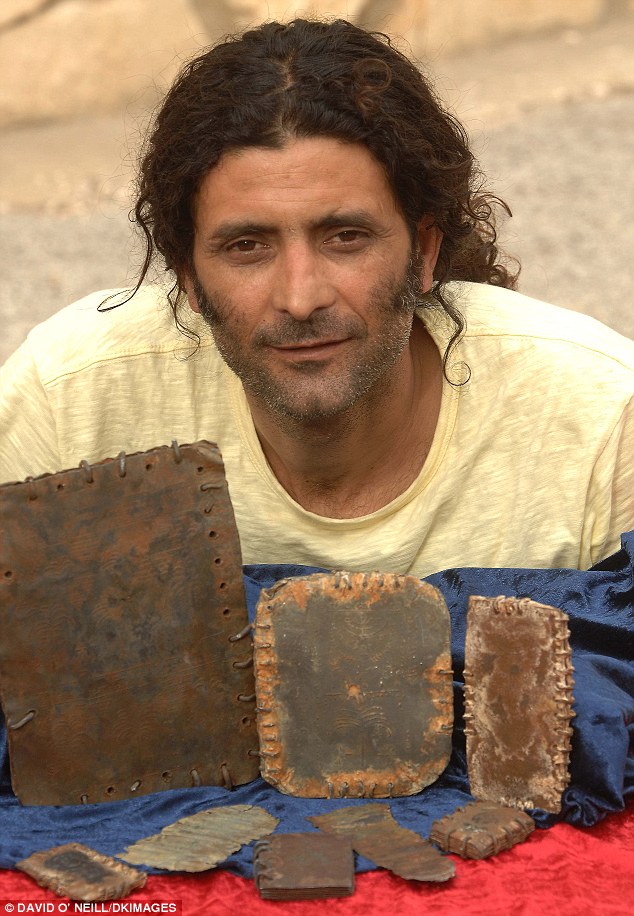
Seventy metal books allegedly discovered in a cave in Jordan have been hailed as the earliest Christian documents. Dating them to mere decades after Jesus' death, scholars have called the "lead codices" the most important discovery in archaeological history, and leading media outlets have added fuel to the fire surrounding the books in recent weeks.
"Never has there been a discovery of relics on this scale from the early Christian movement, in its homeland and so early in its history," reported the BBC. [Image]
Slowly, though, more and more questions have arisen about the authenticity of the codices, whose credit-card-size pages are cast in lead and bound together by lead rings. Today, an Aramaic translator has completed his analysis of the artifacts, and has found what he says is incontrovertible evidence that they are fakes.
...
"I obtained photos of all the text that was available, and spent the past week looking over them," said Steve Caruso, a professional Aramaic translator and teacher who is consulted by dealers of antiquities to analyze inscriptions on ancient artifacts.

"I noticed there were a lot of Old Aramaic forms that were at least 2,500 years old. But they were mixed in with other

forms that were younger, so I took a closer look at that and pulled out all the distinct forms that I could find," Caruso told Life's Little Mysteries. "It was very, very odd — I've never seen this kind of mix before." The youngest scripts he identified, called Nabatean and Palmyrene, date from the second and third centuries, proving the documents could not possibly have been written during the dawn of Christianity, Caruso said.
Even the oldest scripts were written by someone who didn't know what he was doing, the new analysis shows. "There were inconsistencies in how they did the stroke order, which you would never have seen. Scribes had very specific ways of doing things," Caruso said. Furthermore, several characters appeared "flipped" — a mistake that would imply they were hastily copied rather than original. ...
"I was a little bit surprised that they did take on as much media coverage as they did," Caruso said. "The media took the press release hook, line and sinker without doing serious investigation. If they had they would have found that David Elkington, who brought them to the forefront, is in the fringe of academia."
Some good photos and good timing probably gave the artifacts a boost. "I think there were a lot of really, really good photos, and the whole thing seemed convincing on the surface. People are looking for something to write about in the Easter season and this is something that would make great news."
Fake Christian relics are relatively common, Bowes said. "Modern people's urge to find material evidence from the first two centuries of Christianity is much stronger than the actual evidence itself. ...via Exclusive: Early Christian Lead Codices Now Called Fakes | Christian Artifacts Are Forgeries | Life's Little Mysteries.

I wonder if the forger was the real "eerily familiar" face of Jesus in the forgery.
Archaeologists Uncover Evidence of a Minoan Presence Among Ancient Canaanites
A recent and ongoing excavation at the remains of an expansive Middle Bronze Age Canaanite palace in the western Galilee region of present-day Israel is opening a new window on the possible presence of ancient Minoans at an ancient Canaanite palace, revealing what may be the earliest known Western art found in the eastern Mediterranean. Known as Tel Kabri located near its namesake kibbutz not far from historic Acco and the resort town of Nahariya on the coast of Israel, the site features an early Middle Bronze Age MB I palace dated to the 19th century B.C.E., making it, along with ancient Aphek and possibly Megiddo, the earliest MB palace discovered in present-day Israel. This conclusion was drawn as a result of excavations conducted there as recently as December 20, 2010 to January 10, 2011. But the tell-tale signs of an Aegean presence or influence at the site show up in a later developmental phase of the palace structure some 150 to 200 years later in the overlying MB II palace dated to the 17th century.
via Archaeologists Uncover Evidence of a Minoan Presence Among Ancient Canaanites | popular archaeology -.
Monday, April 11, 2011
Olive branch solves a Bronze Age mystery
This collapsed main staircase is one of the remains uncovered at Akrotiri, once a major prehistoric settlement on Santorini
Compared to the well-studied world of Homer’s Iliad and Odyssey, the civilizations that flourished in the eastern Mediterranean just before Homer’s time are still cloaked in mystery.
Even the basic chronology of the region during this time has been heatedly debated. Now, a resolution has finally emerged -- initiated, quite literally, by an olive branch.
Scientists have discovered the remains of a single olive tree, buried alive during a massive volcanic eruption during the Late Bronze Age. A study that dates this tree, plus another study that dates a series of objects from before, during and after the eruption, now offer a new timeline for one of the earliest chapters of European civilization.
The new results suggest that the sophisticated and powerful Minoan civilization (featured in the legend of Theseus and the Minotaur) and several other pre-Homeric civilizations arose about a century earlier and lasted for longer than previously thought.
The new timeframe also downplays Egypt’s role in the region,
suggesting that the cultures of the Levant, the stretch of land that includes Syria, Israel and Palestine, may have been a more important outside influence. ...
During the Late Bronze Age, large building complexes appeared on Crete and later on mainland Greece as part of the Minoan “New Palace” civilization. At its high point, this civilization seems to have been the dominant cultural and economic force across the region, as the result of trade rather than military strength. On Santorini, a major prehistoric settlement called Akrotiri was buried by the Minoan eruption, preserving what’s often called “the Pompeii of the Aegean.” Archeologists have uncovered three- and four-story houses and many other finds there, including an extraordinary collection of wall paintings that offer a glimpse into Minoan life. Women apparently played important civic and religious roles, including joining men in the sport of “bull-leaping,” which seems to have been religiously significant and as dangerous as the name implies. ...
via Olive branch solves a Bronze Age mystery - Technology & science - Science - Mysteries of the Universe - msnbc.com.
Ancient stone markers warned of tsunamis in Japan
Modern sea walls failed to protect coastal towns from Japan's destructive tsunami last month. But in the hamlet of Aneyoshi, a single centuries-old tablet saved the day.
"High dwellings are the peace and harmony of our descendants," the stone slab reads. "Remember the calamity of the great tsunamis. Do not build any homes below this point."
It was advice the dozen or so households of Aneyoshi heeded, and their homes emerged unscathed from a disaster that flattened low-lying communities elsewhere and killed thousands along Japan's northeastern shore.
Hundreds of such markers dot the coastline, some more than 600 years old. Collectively they form a crude warning system for Japan, whose long coasts along major fault lines have made it a repeated target of earthquakes and tsunamis over the centuries.
The markers don't all indicate where it's safe to build. Some simply stand — or stood, washed away by the tsunami — as daily reminders of the risk. "If an earthquake comes, beware of tsunamis," reads one. In the bustle of modern life, many forgot.
More than 12,000 have been confirmed dead and officials fear the death toll could rise to 25,000 from the March 11 disaster. More than 100,000 are still sheltering in schools and other buildings, almost a month later. A few lucky individuals may move into the first completed units of temporary housing this weekend. ...
via Ancient stone markers warned of tsunamis - CBS News.
Tuesday, April 5, 2011
Clogged arteries found in mummy
THE first known case of clogged arteries, or atherosclerosis, has been found in the mummy of an Egyptian princess, a study presented at a major US cardiology conference says.
Researchers have long known that ancient Egyptians suffered from plaque build-up in the arteries that supply the heart, but the latest finding suggests the syndrome may be more prevalent, and mysterious, than previously thought.
''Commonly, we think of coronary artery or heart disease as a consequence of modern lifestyles, mainly because it has increased in developing countries as they become more Westernised,'' said Gregory Thomas of the University of California, Irvine. ''These data point to a missing link in our understanding of heart disease, and we may not be so different from our ancestors.''
Advertisement: Story continues below
Researchers performed computerised tomography (CT) scans on 52 Egyptian mummies to determine whether they had atherosclerosis. Of the 44 that had detectable arteries or hearts, 45 per cent had calcium build-ups in their vessel walls.
The oldest was an Egyptian princess who is thought to have lived between 1580 and 1550 BC, and probably died when she was in her early 40s, researchers believe.
Even though ancient Egyptians ate a leaner diet and did not smoke cigarettes, they ended up with the same disease as modern humans.
But that does not mean people should disregard modern research, said the co-author of the study, Adel Allam of al-Azhar University in Cairo. ''Recent studies have shown that by not smoking, having a lower blood pressure and a lower cholesterol level, calcification of our arteries is delayed,'' he said.AFP
via Clogged arteries found in mummy.
Monday, April 4, 2011
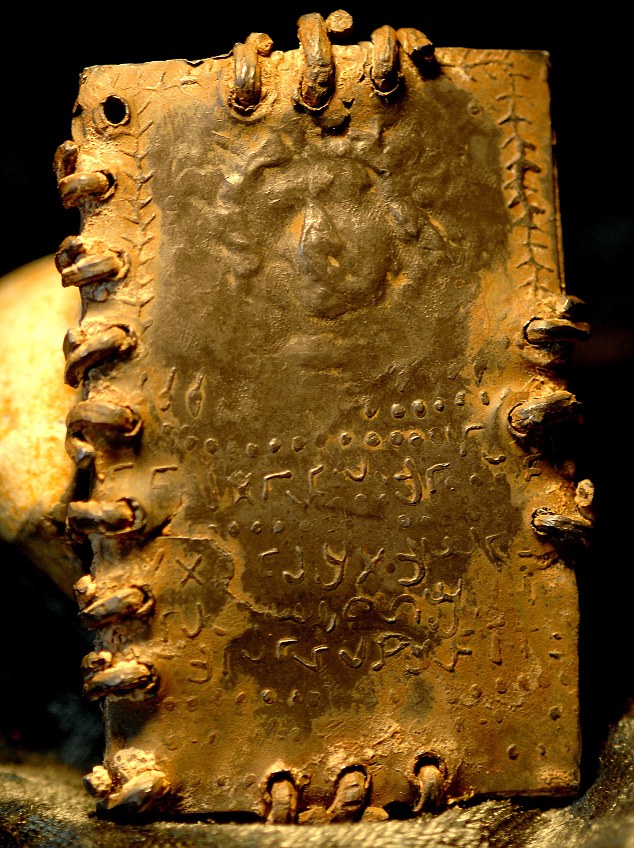
Hidden in a cave: First ever portrait of Jesus found in 1 of 70 ancient books?
Nick Pryer - The image is eerily familiar: a bearded young man with flowing curly hair. After lying for nearly 2,000 years hidden in a cave in the Holy Land, the fine detail is difficult to determine. But in a certain light it is not difficult to interpret the marks around the figure’s brow as a crown of thorns.
The extraordinary picture of one of the recently discovered hoard of up to 70 lead codices – booklets – found in a cave in the hills overlooking the Sea of Galilee is one reason Bible historians are clamouring to get their hands on the ancient artefacts.
If genuine, this could be the first-ever portrait of Jesus Christ, possibly even created in the lifetime of those who knew him. ..
via Hidden in a cave: First ever portrait of Jesus found in 1 of 70 ancient books? | Mail Online.
The reason this image is "eerily familiar" is because it looks like one of the Pirates of the Caribbean. ;-)
Crown of thorns? I think you are imagining things there, but how about those three horns coming out of his head? Hard to miss those. And what about that pointy elf ear?
I'll be interested to hear what the translation says is written under the face if this continues to play out as a real artifact.
It looks to me like this grinning person has a short triangular nose.
Subscribe to:
Posts (Atom)