... The group was led by Dorothy Martin, a Dianetics devotee who transcribed the interstellar messages through automatic writing.
Through her, the aliens had given the precise date of an Earth-rending cataclysm: December 21, 1954. Some of Martin's followers quit their jobs and sold their property, expecting to be rescued by a flying saucer when the continent split asunder and a new sea swallowed much of the United States. The disciples even went so far as to remove brassieres and rip zippers out of their trousers—the metal, they believed, would pose a danger on the spacecraft.
At first, the group struggled for an explanation. But then rationalization set in. A new message arrived, announcing that they'd all been spared at the last minute. Festinger summarized the extraterrestrials' new pronouncement: "The little group, sitting all night long, had spread so much light that God had saved the world from destruction." Their willingness to believe in the prophecy had saved Earth from the prophecy!
From that day forward, the Seekers, previously shy of the press and indifferent toward evangelizing, began to proselytize. "Their sense of urgency was enormous," wrote Festinger. The devastation of all they had believed had made them even more certain of their beliefs.
In the annals of denial, it doesn't get much more extreme than the Seekers. They lost their jobs, the press mocked them, and there were efforts to keep them away from impressionable young minds. But while Martin's space cult might lie at on the far end of the spectrum of human self-delusion, there's plenty to go around. And since Festinger's day, an array of new discoveries in psychology and neuroscience has further demonstrated how our preexisting beliefs, far more than any new facts, can skew our thoughts and even color what we consider our most dispassionate and logical conclusions. This tendency toward so-called "motivated reasoning" helps explain why we find groups so polarized over matters where the evidence is so unequivocal: climate change, vaccines, "death panels," the birthplace and religion of the president (PDF), and much else. It would seem that expecting people to be convinced by the facts flies in the face of, you know, the facts. ...
Consider a person who has heard about a scientific discovery that deeply challenges her belief in divine creation—a new hominid, say, that confirms our evolutionary origins. What happens next, explains political scientist Charles Taber of Stony Brook University, is a subconscious negative response to the new information—and that response, in turn, guides the type of memories and associations formed in the conscious mind. "They retrieve thoughts that are consistent with their previous beliefs," says Taber, "and that will lead them to build an argument and challenge what they're hearing."
In other words, when we think we're reasoning, we may instead be rationalizing. ...
Modern science originated from an attempt to weed out such subjective lapses—what that great 17th century theorist of the scientific method, Francis Bacon, dubbed the "idols of the mind." Even if individual researchers are prone to falling in love with their own theories, the broader processes of peer review and institutionalized skepticism are designed to ensure that, eventually, the best ideas prevail.
Our individual responses to the conclusions that science reaches, however, are quite another matter. Ironically, in part because researchers employ so much nuance and strive to disclose all remaining sources of uncertainty, scientific evidence is highly susceptible to selective reading and misinterpretation. ...
And it's not just that people twist or selectively read scientific evidence to support their preexisting views. According to research by Yale Law School professor Dan Kahan and his colleagues, people's deep-seated views about morality, and about the way society should be ordered, strongly predict whom they consider to be a legitimate scientific expert in the first place—and thus where they consider "scientific consensus" to lie on contested issues. ...
In one study, subjects in the different groups were asked to help a close friend determine ... risks .... The results were stark ... people rejected the validity of a scientific source because its conclusion contradicted their deeply held views...
The study subjects weren't "anti-science"—not in their own minds, anyway. It's just that "science" was whatever they wanted it to be. "We've come to a misadventure, a bad situation where diverse citizens, who rely on diverse systems of cultural certification, are in conflict," says Kahan.
And that undercuts the standard notion that the way to persuade people is via evidence and argument. In fact, head-on attempts to persuade can sometimes trigger a backfire effect, where people not only fail to change their minds when confronted with the facts—they may hold their wrong views more tenaciously than ever. ...
Take, for instance, the question of whether Saddam Hussein possessed hidden weapons of mass destruction just before the US invasion of Iraq in 2003. When political scientists Brendan Nyhan and Jason Reifler showed subjects fake newspaper articles (PDF) in which this was first suggested (in a 2004 quote from President Bush) and then refuted (with the findings of the Bush-commissioned Iraq Survey Group report, which found no evidence of active WMD programs in pre-invasion Iraq), they found that conservatives were more likely than before to believe the claim. ...
via The Science of Why We Don't Believe Science | Mother Jones.
Showing posts with label Education. Show all posts
Showing posts with label Education. Show all posts
Thursday, April 21, 2011
The Science of Why We Don't Believe Science


Monday, April 18, 2011
Transcranial direct-current stimulation improves learning in military simulation
Last year a succession of volunteers sat down in a research lab in Albuquerque, New Mexico to play DARWARS Ambush!, a video game designed to train US soldiers bound for Iraq. Each person surveyed virtual landscapes strewn with dilapidated buildings and abandoned cars for signs of trouble — a shadow cast by a rooftop sniper, or an improvised explosive device behind a rubbish bin. With just seconds to react before a blast or shots rang out, most forgot about the wet sponge affixed to their right temple that was delivering a faint electric tickle. The volunteers received a few milliamps of current at most, and the simple gadget used to deliver it was powered by a 9-volt battery.
It might sound like some wacky garage experiment, but Vincent Clark, a neuroscientist at the University of New Mexico, says that the technique, called transcranial direct-current stimulation (tDCS), could improve learning. The US Defense Advanced Research Projects Agency funded the research in the hope that it could be used to sharpen soldiers' minds on the battlefield. Yet for all its simplicity, it seems to work.
Volunteers receiving 2 milliamps to the scalp (about one-five-hundredth the amount drawn by a 100-watt light bulb) showed twice as much improvement in the game after a short amount of training as those receiving one-twentieth the amount of current1. "They learn more quickly but they don't have a good intuitive or introspective sense about why," says Clark.
The technique, which has roots in research done more than two centuries ago, is experiencing something of a revival. Clark and others see tDCS as a way to tease apart the mechanisms of learning and cognition. As the technique is refined, researchers could, with the flick of a switch, amplify or mute activity in many areas of the brain and watch what happens behaviourally. The field is "going to explode very soon and give us all sorts of new information and new questions", says Clark. And as with some other interventions for stimulating brain activity, such as high-powered magnets or surgically implanted electrodes, researchers are attempting to use tDCS to treat neurological conditions, including depression and stroke. But given the simplicity of building tDCS devices, one of the most important questions will be whether it is ethical to tinker with healthy minds — to improve learning and cognition, for example. ... The jury is still out on whether these results will translate into real-world benefits. Nitsche says that it will be harder to improve cognition in young, healthy people — whose minds are theoretically already optimized — than in elderly people or those with addictions, for instance. "I wouldn't say it wouldn't be possible," says Nitsche. "But things might be a little more complicated."That's not stopping some people from trying it at home. Discussions are already appearing on the Internet: buy a 9-volt battery, some wire and a resistor, and you're theoretically there. One person, hoping to improve his concentration, was alarmed by the flashing lights he experienced — a commonly reported side effect, along with burning or itching at the site of the electrode. "I probably won't be doing this again," he said in a message posted online. Another wrote in an online patients' forum that the tDCS treatments he was giving to his wife were alleviating her chronic pain. Safety is an important issue. "With wires and batteries and home hobbyists trying to run electricity through their heads, somebody could get hurt," says Farah. ...
via Neuroscience: Brain buzz : Nature News.

Thursday, April 14, 2011
Classroom 'slave sale' prompts parent protests
Trying to bring a history lesson on the American Civil War to life, teacher Jessica Boyle turned her fourth grade Norfolk, Virginia, classroom into a slave auction: she ordered black and mixed-race students to one side of the classroom; then the white students took turns buying them.
Parent complaints began rolling in shortly after the April 1st lesson, and the principal at Sewells Point Elementary School, Mary Wrushen, told parents in a letter last week that Ms Boyle had gone too far.
“The lesson could have been thought through more carefully, as to not offend her students or put them in an uncomfortable situation,” Ms Wrushen wrote.
Lessons on the civil war have long been among the most sensitive topics in Virginia classrooms, many located near the grounds of the Confederacy’s bloodiest battles. And the role that slavery played in the conflict’s origins has been particularly controversial.
Ms Boyle’s attempt to drive home the connection between slavery and war took place in an elementary school named for one of Virginia’s earliest civil war skirmishes, the Battle of Sewells Point, which was fought within sight of the school grounds, near the mouth of Hampton Roads. Ms Boyle taught her lesson less than two weeks before the 150th anniversary of the conflict.
“She had not conducted a mock slave auction in class before,” Norfolk public schools spokeswoman Elizabeth Thiel Mather wrote in a statement.
She added that “appropriate personnel action is being taken” but would not discuss the details.
Ms Boyle has been teaching in Norfolk for six years.
Sewells Point’s fourth grade class is about 40 per cent black and 40 per cent white. ...
via Classroom 'slave sale' prompts parent protests - The Irish Times - Wed, Apr 13, 2011.

Simulations are all the rage. I'm hearing that one school in my area is having some children "killed" in drunk driving accidents. The "drunk driver" in the simulation is really arrested and really spends time in jail. The "dead kids" are taken and hidden away during the exercise and their parents must really go to the coroners office to ID the bodies. A school assembly is held and the obituaries of the kids killed are read. I think this could save some lives because the risks of kids drinking and driving are real. I'm not so sure, however, that kids are at risk of becoming slave owners in Norfolk, Virginia. I've never been there, so I can't say for sure...
Monday, March 28, 2011
Students making science videos gives better learning and clearer understanding of the concepts
Geoff Hilton- Making a video about a scientific experiment rather than writing up a presentation poster leads to better learning and clearer understanding of the concepts underpinning the experiment according to science educators in Australia. Writing in the International Journal of Innovation and Learning, the researchers explain how preparation and rehearsals for video production also helped with learning.
Geoff Hilton of the School of Education, at the University of Queensland in Brisbane asked two groups of year 7 students (one class with 21 students, one with 22) of mixed ability and mixed gender to complete a science investigation. One group was asked to record their findings in a written format to produce a science poster as the final part of the work. The second group was asked to produce a video instead. Hilton found that the completion of these two types of task once the science experiment was completed, elicited from the students a number of different behaviors that influenced their learning,
While many educators the world over are exploring the cutting edge of technology, much work remains to be done to explore how such rapidly developing digital technologies might improve education and so learning. Digital video might enhance learning, particularly by allowing students to capture the active, experimental, and visual nature of science. But, this notion beggars the question as to whether video would improve learning when compared with more conventional approaches. ...
via Video skilled the students so far.
Good to know and I hope kids will make more science videos.
I always thought the phrase was "begs the question" not "beggars the question." Is "beggars the question" an Australian term? It has 95,000 results in a Google search compared to 1,920,000 results for "begs the question". If I was writing this, I would have said this "raises the question". One person says "beggars the question" is used in the sense that it "makes of the question a beggar by assuming the answer."
Thursday, March 17, 2011
Are the wealthiest countries the smartest countries?
Tiffany Harrington - It's not just how free the market is. Some economists are looking at another factor that determines how much a country's economy flourishes: how smart its people are. For a study published in an upcoming issue of Psychological Science, researchers analyzed test scores from 90 countries and found that the intelligence of the people, particularly the smartest 5 percent, made a big contribution to the strength of their economies.
In the last 50 years or so, economists have started taking an interest in the value of human capital. That means all of the qualities of the people who make up the workforce. Heiner Rindermann, of the Chemnitz University of Technology, wanted to look more closely at human capital, and particularly the factor that psychologists call cognitive ability. "In other words, it's the ability of a person to solve a problem in the most efficient way—not with violence, but by thinking," Rindermann says. He wrote the new study with James Thompson of University College London.
The researchers collected information on 90 countries, including far-off lands from the U.S. to New Zealand and Colombia to Kazakhstan. They also collected data on the country's excellence in science and technology—the number of patents granted per person and how many Nobel Prizes the country's people had won in science, for example.
They found that intelligence made a difference in gross domestic product. For each one-point increase in a country's average IQ, the per capita GDP was $229 higher. It made an even bigger difference if the smartest 5 percent of the population got smarter; for every additional IQ point in that group, a country's per capita GDP was $468 higher.
"Within a society, the level of the most intelligent people is important for economic productivity," Rindermann says. He thinks that's because "they are relevant for technological progress, for innovation, for leading a nation, for leading organizations, as entrepreneurs, and so on." Since Adam Smith, many economists have assumed that the main thing you need for a strong economy is a government that stays out of the way. "I think in the modern economy, human capital and cognitive ability are more important than economic freedom," Rindermann says.
via Are the wealthiest countries the smartest countries?.
Monday, February 14, 2011
Study Shows Year-end Test Scores Significantly Improved in Schools Using Web-based Tutor
Year-end test scores of Massachusetts middle school students whose teachers used ASSISTments, a Web-based tutoring platform developed at Worcester Polytechnic Institute (WPI), as a central part of their mathematics instruction were significantly better than those of students whose teachers did not use the platform, according to a recent study published in the Journal of Educational Computing Research. Conducted by Neil T. Heffernan, PhD, of WPI, and Kenneth R. Koedinger, PhD, and Elizabeth A. McLaughlin, both of Carnegie Mellon University, the study examined data collected from 1,240 seventh grade students in four schools in an urban Massachusetts school district.
... ASSISTments (the name blends tutoring "assistance" with student "assessments") helps students learn by presenting them with problems and then offering carefully structured assistance. The software records how students use the system and meticulously tracks their progress. The system has been developed at WPI over the past decade wi th more than $9 million in support from the National Science Foundation, the U.S. Department of Education, and other federal and state agencies.
At WPI, the ASSISTments platform is the heart of a research and school collaborative that currently includes 35 school districts across the United States that use the system for instruction and assessment and help improve it by adding content. ASSISTments lets teachers add content in any domain. WPI has received funding to create middle school math and science libraries, but teachers elsewhere have used the platform to develop content for such diverse topics such as English and French vocabulary and training teachers to recognize common misconceptions. ...
WPI's award-winning research has demonstrated that consistent use of ASSISTments significantly improves both testing and learning. Massachusetts has the most active participation in ASSISTments—hundreds of teachers and thousands of students use the tool in daily classwork and homework. ...
via Study Shows Year-end Test Scores Significantly Improved in Schools Using Web-based Tutor - WPI.
Thursday, January 27, 2011
First Beatles graduate is announced
A Canadian singer has become the first person in the world to graduate with a Masters degree in The Beatles.
Former Miss Canada finalist Mary-Lu Zahalan-Kennedy, 53, was one of the first students to sign up for the course on the Fab Four when it launched at Liverpool Hope University in March 2009.
Twelve full-time students joined the Master of Arts course in The Beatles, Popular Music and Society that year and Mary-Lu is the first from her class to graduate.
She said: "I am so proud of my achievement. The course was challenging, enjoyable and it provided a great insight into the impact The Beatles had and still have to this day across all aspects of life.
"The faculty and students at Liverpool Hope University were crucial in providing an unforgettable experience and their support was invaluable." ...
via First Beatles graduate is announced - Telegraph.
Monday, August 16, 2010
Ofsted warning over 'untracked' children
Ofsted said children out of education and whose whereabouts were unknown risked failing academically and were vulnerable to harm.
That could be physical, emotional or psychological harm, Ofsted said.
Local authorities have a legal duty to ensure all children are in a safe environment and get a suitable education, either at school or home.
...
Ofsted said schools needed to talk to each other and local authorities more effectively to ensure children who were at risk received an education and were protected from mistreatment.
For its report, entitled "Children missing from education", Ofsted surveyed 15 local authorities of different sizes across England in urban and rural areas. ...
"It is of serious concern that some schools are not following agreed procedures and legal requirements for notifying their local authorities when pupils are excluded or taken off the roll."
However, he added that the report did highlight some of the good work local authorities had done to "overcome the challenges in ensuring all the children living in their area are identified and are receiving a suitable education".
Database closure
The death of seven-year-old Khyra Ishaq, in 2008, was a high-profile case of a child suffering from neglect after falling out of the education system.
She died five months after her mother had withdrawn her from school.
The severely malnourished child weighed just 2st 9lb (16.5kg) - when paramedics found her emaciated at her home in Handsworth, Birmingham.
Earlier this month ContactPoint, a £235m government database containing the records of England's 11 million children, was switched off.
The database was established in the wake of the Victoria Climbie child abuse case to aid child protection and its demise sparked concerns that there is no system of collating key information in one place.
The system was used by doctors, social workers, schools, charities and other individuals involved in the protection of children.
via BBC News - Ofsted warning over 'untracked' children.

Typical blind as a bat bureaucratic thinking. No one asks why the kids might go missing in the first place. Fix the cause, don't take a hammer to the symptoms.
Tuesday, June 1, 2010
When science clashes with beliefs? Make science impotent
It's hardly a secret that large segments of the population choose not to accept scientific data because it conflicts with their predefined beliefs: economic, political, religious, or otherwise. But many studies have indicated that these same people aren't happy with viewing themselves as anti-science, which can create a state of cognitive dissonance. That has left psychologists pondering the methods that these people use to rationalize the conflict.
A study published in the Journal of Applied Social Psychology takes a look at one of these methods, which the authors term "scientific impotence"—the decision that science can't actually address the issue at hand properly. It finds evidence that not only supports the scientific impotence model, but suggests that it could be contagious. Once a subject has decided that a given topic is off limits to science, they tend to start applying the same logic to other issues.
The paper is worth reading for the introduction alone, which sets up the problem of science acceptance within the context of persuasive arguments and belief systems. There's a significant amount of literature that considers how people resist persuasion, and at least seven different strategies have been identified. But the author, Towson University's Geoffrey Munro, attempts to carve out an exceptional place for scientific information. "Belief-contradicting scientific information may elicit different resistance processes than belief-contradicting information of a nonscientific nature," he argues. "Source derogation, for example, might be less effective in response to scientific than nonscientific information."
It might be, but many of the arguments against mainstream science make it clear that it's not. Evolution doubters present science as an atheistic conspiracy; antivaccination advocates consider the biomedical research community to be hopelessly corrupted by the pharmaceutical industry; and climatologists have been accused of being in it to foster everything from their own funding to global governance. Clearly, source derogation is very much on the table. ...
Within the scientific community, there has been substantial debate over how best to deal with the public's refusal to accept basic scientific findings, with different camps arguing for increasing scientific literacy, challenging beliefs, or emphasizing the compatibility between belief and science. Confirming that the scientific impotence phenomenon is real might induce the scientific community to consider whether any of the public engagement models they're currently arguing over would actually be effective at addressing this issue.
via When science clashes with beliefs? Make science impotent.
Friday, April 23, 2010
Sounds Make Memories Stick During Sleep
A good night's sleep, or even just a nap, can be an aid to memory. Psychologists have known for years that sleep solidifies what we've learned during the day, transforming tenuous associations into stable ones. Learning while you snooze seems supremely efficient, and so people have long dreamed of co-opting this process so that their dozing brain shores up what matters to them—say, material they've studied for a test or a talk, or verbiage in a foreign language they want to master. But until now there has been little support for the notion that studying in your sleep is useful. Psychology graduate student John Rudoy at Northwestern University in Illinois reported findings here on Monday at the Cognitive Neuroscience Society 2010 annual meeting that hint at a way to do that.
Rudoy, who works in neuroscientist Ken Paller's group, and his colleagues showed study participants 50 photographs and asked them to memorize where each one appeared on a computer screen. To help the participants remember the locations, the researchers asked them to practice moving each picture to where they thought it had appeared, and after they’d made their move, showed them the picture's correct location. In addition, the participants were taught to associate each photograph with a distinct sound—say, a chirp, ring, buzz or tone—that was related to the image. For example, the sound of an object hitting the water accompanied a picture of a splash.
The participants then took a nap lasting for up to 90 minutes in an easy chair in the laboratory. As they dozed, the investigators exposed the subjects to 25 distinct sounds—the ones they had associated with half of the photographs. When the nappers woke up, they again tried to move each of the 50 photographs to its previously assigned spot on a screen.
The sounds did seem to have an effect on memory for location: subjects were far more accurate at placing the pictures they had previously associated with the sounds played during their nap than they were at locating pictures for which they had not heard cues during slumber. The researchers surmise that the noises reinvigorate a complex web of neural connections that comprise our memories and thus strengthen them. Rudoy and his colleagues do not know, however, if this trick would work for memories that differ from the location or "spatial" type; they are also unsure if the sound cues have to be noises or if they could be, say, French words.
Nevertheless, psychologist Michael C. Anderson of the MRC Cognition and Brain Sciences unit in Cambridge, England, was impressed that you can use auditory cues to reinforce specific memories during sleep. "If I were given this as a proposal, I would say it was an interesting idea but it wouldn’t work," Anderson says. "The fact that it did is very cool." The work also suggests, he adds, that what you remember during sleep may be sensitive to your physical environment—and thus may depend, in part, on chance. So if your cat meows or your baby cries during the night, the sound might reactivate and strengthen thoughts about your pet or your child. And if you doze off in a noisy environment, the cacophony might conceivably fortify recollections you might prefer to forget.
via Sounds Make Memories Stick During Sleep: Scientific American.
Inspires me to to create an mp3 I can play while I sleep that plays tones and names them all night. Might help me acquire absolute pitch as long as I do some similar sounding exercise during the day.
Sunday, March 28, 2010
Child Prodigy, 13, Claims UConn Age Bias
Even at 13, Colin Carlson believes he's running out of time. Colin is a sophomore at the University of Connecticut, seeking a bachelor's degree in ecology and evolutionary biology and another in environmental studies. But he's been knocked off course by the university's rejection of his request to take a class that includes summer field work in South Africa. He and his mother say university officials told them he is too young for the overseas course. So he's filed an age discrimination claim with the university and U.S. Department of Education, which is investigating. "I'm losing time in my four-year plan for college," he said. "They're upsetting the framework of one of my majors." Michael Kirk, a spokesman for UConn, would not comment on Colin's case. But he said that generally, safety is the university's first concern when travel is involved. The university would not let Colin enroll, even after his mother, Jessica Offir, offered to release UConn from liability and accompany her son as a chaperone at her own expense, she and Colin said. Colin was 2 or 3 when he began reading on his own, Offir said, and was up to "Harry Potter" by the time he was 4. An only child, he has faced trouble before because of his brainpower. His kindergarten teacher would not allow him to take books with him at nap time, and he was ridiculed by other children who fired math questions at him to entertain themselves, she said. "You have no idea what kids like this experience," Offir said. Colin skipped two grades in public school and began taking psychology, history and other courses at UConn when he was 9. He graduated from Stanford University Online High School at age 11, and soon after enrolled full-time at UConn. "I'm actually like any other student," he said. "The faculty and students have better things to do than worry about a 13-year-old holding his own." Over the years, Colin, who said he is fascinated by natural ecosystems, has traveled extensively. He has gone sea kayaking off Nova Scotia and Ecuador, hiked in numerous national parks and, with his mother, has traveled across the U.S. by car. "It's important to have a very wide world view," he said. "Biology is fundamentally about the diversity of life, with a focus across the planet." - cbsnews

Thursday, March 4, 2010
Rowdy students block campus amid funding rally
Rowdy protesters blocked the main gates of a California university Thursday amid campus protests across the nation against deep cuts in education funding.
University of California, Santa Cruz provost David Kliger said there were reports of protesters carrying weapons and damaging a vehicle. Police did not immediately confirm the reports.
An advisory posted on the school Web site urged people to avoid the campus because of safety concerns.
It said a windshield was reported smashed and protesters had photographed the license plate of a staff member trying to enter the campus.
Marches, strikes, teach-ins and walkouts were planned nationwide in what was being called the March 4th National Day of Action for Public Education.
Organizers said hundreds of thousands of students, teachers and parents were expected to participate in the demonstrations.
Some university officials said they supported the protests as long as they remained peaceful.
"My heart and my support are with everybody and anybody who wants to stand up for public education," University of California President Mark Yudof said in a statement. "Public education drives a society's ability to progress and to prosper."
The steep economic downturn has forced states to slash funding to K-12 schools, community colleges and universities to cope with plummeting tax revenue.
Experts said schools and colleges could face more severe financial trouble over the next few years as they drain federal stimulus money that temporarily prevented widespread layoffs and classroom cuts.
Protest actions were held at most of the 10 University of California campuses, 23 California State University campuses and many of the state's 110 community colleges.
Demonstrations were also planned at universities in New York, Alabama, Michigan and Massachusetts.
Students, teachers and school employees from across California were gathering in Sacramento for a midday rally at the Capitol to urge lawmakers to restore funding to public schools. ...
via Rowdy students block campus amid funding rally - Yahoo! News.
Sunday, February 21, 2010
Neuroscientist: Think twice about cutting music in schools
... "People's hearing systems are fine-tuned by the experiences they've had with sound throughout their lives," says Kraus. "Music training is not only beneficial for processing music stimuli. We've found that years of music training may also improve how sounds are processed for language and emotion."
Researchers in the Kraus lab provided the first concrete evidence that playing a musical instrument significantly enhances the brainstem's sensitivity to speech sounds. The findings are consistent with other studies they have conducted revealing that anomalies in brainstem sound encoding in some learning disabled children can be improved with auditory training.
The Kraus lab has a unique approach for demonstrating how the nervous system responds to the acoustic properties of speech and music sounds with sub-millisecond precision. The fidelity with which they can access the transformation of the sound waves into brain waves in individual people is a powerful new development.
The neural enhancements seen in individuals with musical training is not just an amplifying or volume knob effect," says Kraus. "Individuals with music training show a selective fine-tuning of relevant aspects of auditory signals."
By comparing brain responses to predictable versus variable sound sequences, Kraus and her colleagues found that an effective or well-tuned sensory system takes advantage of stimulus regularities, such as the sound patterns that distinguish a teacher's voice from competing sounds in a noisy classroom.
They previously found that the ability of the nervous system to utilize acoustic patterns correlates with reading ability and the ability to hear speech in noise. Now they have discovered that the effectiveness of the nervous system to utilize sound patterns is linked to musical ability.
"Playing music engages the ability to extract relevant patterns, such as the sound of one's own instrument, harmonies and rhythms, from the 'soundscape,'" Kraus says. "Not surprisingly, musicians' nervous systems are more effective at utilizing the patterns in music and speech alike." ...
via Neuroscientist: Think twice about cutting music in schools.

Right. Music is essential. It is vitamin M.
PS. I re-posted a few of my older songs tonight (box.net on the left) with some new tweaks.
Saturday, January 16, 2010
Tuesday, December 8, 2009
Study: Parents' Sex Talks with Kids Happening Too Late
... ironically, despite their apparent dread, kids really want to learn about sex from their parents, according to study after study on the topic. (See pictures of teenagers in America.)
"The results didn't surprise me," says Dr. Mark Schuster, one of the authors of the new study, published in Pediatrics, and chief of general pediatrics at Children's Hospital Boston. "But there's something about having actual data that serves as a wake-up call to parents who are not talking to their kids about very important issues until later than we think would be best."
The study involved 141 families enrolled in the Talking Parents, Healthy Teens program, organized by the University of California Los Angeles/Rand Center for Adolescent Health Promotion and overseen by Schuster. Parents and their children, aged 13 to 17, responded to questions about 24 issues regarding sex and sexuality, including how women become pregnant, body changes that occur during puberty, how to use condoms and birth control, as well as issues around homosexuality. (See the top 10 teen idols.)
Researchers asked both parents and their children, separately, when they had first discussed each topic, and compared that information to teens' self-reports about their engagement in three specific categories of sexual behavior - hand-holding or kissing; genital touching or oral sex; and intercourse. Families were surveyed four times, once at the beginning of the study, then again at three, six and 12 months.
By the end of the study, more than half of the parents reported that they had not discussed 14 of the 24 sex-related topics by the time their adolescents had begun genital touching or oral sex with partners. Forty-two percent of girls reported that they had not discussed the effectiveness of birth control and 40% admitted they had not talked with their parents about how to refuse sex before engaging in genital touching. Nearly 70% of boys said they had not discussed how to use a condom or other birth-control methods with their parents before having intercourse. Yet only half of the boys' parents, by contrast, said they had not discussed condom use or birth control with their sons. ...
via Study: Parents' Sex Talks with Kids Happening Too Late - Yahoo! News.
Monday, November 30, 2009
Phone box has new life as library
A traditional red phone box has been recycled into one of the country's smallest lending libraries - stocking 100 books.
Villagers from Westbury-sub-Mendip in Somerset can use the library around the clock, selecting books, DVDs and CDs.
Users simply stock it with a book they have read, swapping it for one they have not.
"It's really taken off. The books are constantly changing," said parish councillor Bob Dolby.
He added: "It is completely full at the moment with books. Anyone is free to come and take a book and leave one that you have already read.
"This facility has turned a piece of street furniture into a community service in constant use."
A resident dreamed up the idea when the village lost its phone box and mobile library in quick succession.
Westbury-sub-Mendip Parish Council bought the phone box from BT in a national scheme for a token £1.
BT has received 770 applications for communities to 'adopt a kiosk', and so far 350 boxes have been handed over to parish councils.
Phone boxes have been turned into art installations, a shower and even a public toilet.
via BBC News - Phone box has new life as library.
Sunday, November 1, 2009
State SAT scores and $ spent per student ranking
The "best and worst states" web site has some interesting information. It seems SAT scores are not related to the amount spent on each student per state.
State SAT Scores 2009
... Some states have low participation rates and arguably can tilt the field. ...
Top SAT State Scores include Iowa, Wisconsin,
Minnesota and Missouri. These States primarily have their students take the ACT test so their numbers may not be representative of the entire state.
The Worst States for SAT Scores include Maine, Hawaii,
South Carolina, Georgia and New York. DC is also very low
... While the quality of education may be influenced by the amount of money spent, spending more money does not insure that students actually learn more. We found it interesting to note how money spent and SAT scores were associated.
... The highest spending state, Vermont, is rated 30th in SAT scores nationwide. The lowest spending state, Utah, gets higher SAT scores from their students and is ranked 20th above Vermont. Far less money, higher score.
The Best State (highest) SAT score comes from Iowa yet their spending of $9,977 per student is right in the middle at 25th and right at the national average of spending. The Worst State Sat score comes from Maine yet it spends the 5th most money in the nation.
With all the spending coming out of Congress, we might want to ask for more accountability on results. The various state legislatures, that are making spending decisions, clearly can not show that more money leads to better results. Check out our previous post on Best and Worst State SAT Scores
via Best and Worst States: Does Spending More on Education Work? State Rankings of Education Spending..

![[UNKNOWN]](https://lh3.googleusercontent.com/blogger_img_proxy/AEn0k_tJQ46LCdiwX-IK9w03-6YPbpysXs44XyKG9cQW5s6x0JNAb9IpUtPBfIBTQU_nxe5FCLrWD9rj_ko5sAXFA2U8GpQn70VGHEaXyHC2m6eU11qOcNBsxwel=s0-d)
Friday, October 30, 2009
Xeno’s Absolute Pitch System: Lesson 2, Middle C in the context of other keys
Xeno’s Absolute Pitch System: Lesson 2, Middle C in the context of other keys.
Lesson two provides your ear with something critical that it has likely never heard until now: how a C note relates to all of the other keys in western music.
Listen: Download or play Lesson 2 here.

Instructions:
Just listening to this lesson starts to set up note permanence in your brain, but the process will go even faster if you do this...
- In the first part with the scales, listen closely to the soft middle C note in the background.
- Attempt to sing a C note right before the C note plays at the end of each small song in each key.
Listening actively this way will turn on the light and you will finally "get" that a "C" is always there, always a "C" no matter what else is going on.
Learn to hear Middle C in relation to music in other keys today. Don't forget Lesson 1!
Results:
Three random tests during the day hours after listening to this allowed me to recall middle C correctly. This ability was gone the next morning, however. I guess we need a lesson 3... ;-)
Lesson two provides your ear with something critical that it has likely never heard until now: how a C note relates to all of the other keys in western music.
Listen: Download or play Lesson 2 here.
Instructions:
Just listening to this lesson starts to set up note permanence in your brain, but the process will go even faster if you do this...
- In the first part with the scales, listen closely to the soft middle C note in the background.
- Attempt to sing a C note right before the C note plays at the end of each small song in each key.
Listening actively this way will turn on the light and you will finally "get" that a "C" is always there, always a "C" no matter what else is going on.
Learn to hear Middle C in relation to music in other keys today. Don't forget Lesson 1!
Results:
Three random tests during the day hours after listening to this allowed me to recall middle C correctly. This ability was gone the next morning, however. I guess we need a lesson 3... ;-)
Tuesday, October 27, 2009
Xeno's Absolute Pitch System: Lesson 1, Middle C
Xeno's Absolute Pitch System: Lesson 1, Middle C.
Learn to hear Middle C in relation to music in other keys.
It starts very simple then gets more complicated. Listening to this free music-only music lesson will make you 3% smarter. ;-)
 I've once again been wondering if I missed the boat by not being taught to recognize musical note names when I was 2 to 3 years old (some research says that's the time to do it).
If we can learn as adults to have absolute pitch, it seems we should learn in the same way we learn the names of colors as kids... by playing.
I can hear a "C" note and sing it back several minutes later, but if listen to some music in another key, forget it. The note memory gets erased. Why should I no longer recognize blue after seeing something red?
That got me thinking... we learn colors by comparing them to eachother... mixing them, painting with them ... perhaps I could create a series of compositions that compare notes ... show a note, and then gradually hide it in other notes. "Hide and seek" and peek-a-book fascinate kids for a good reason: they help our brains learn quickly.
Kids do this with colored pens. Color with one, then put it away for a while... then bring it back. This might be a way to learn to still recall a "C" any time at all.
I really don't want to work too hard at this. It should be fun. I just want to wake up one day and be able to recognize any notes I hear by name.
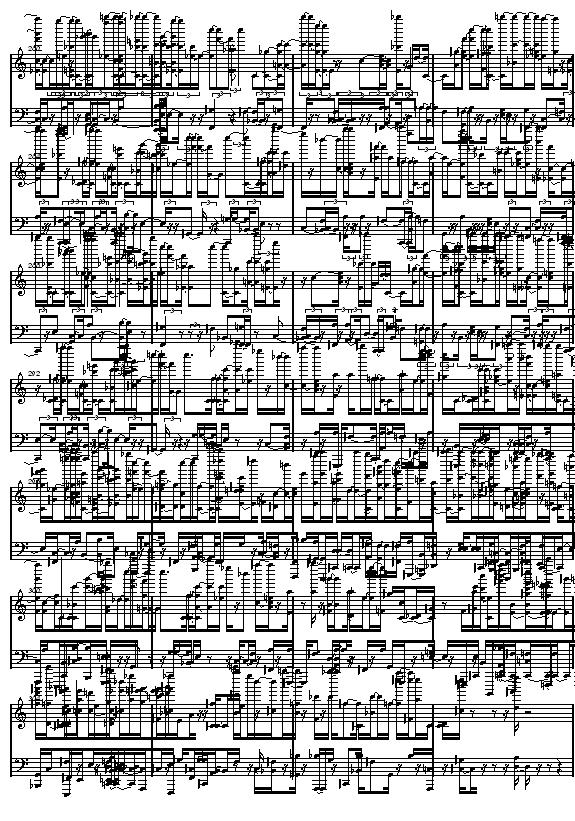
See that crazy sheet music? Believe it or not, that's part of the actual score I wrote played and recorded today for: "Lesson 1 - Middle C". Download it or listen here for free (20 MB MP3).
All you have to do is listen once a day and the song will program your brain. It works by slowly embedding C notes from an 88 key concert piano into somewhat random compositions in various keys. There are many different tricks in this song.
Your brain hears all of this and forms new connections, new associations. The idea is to fix the C in once place in comparison to other keys. This is not something you typically hear in modern western music. Most songs are in a key. It is if we are never shown red and blue at the same time, so we never figure out how they relate.
My hypothesis is that listening to this lesson will help people internalize the C note and thus be able to remember it longer. Let me know if it helps you.
Want Lesson 2? Sign up for Twitter and Follow Me, or subscribe to the RSS feed.
Learn to hear Middle C in relation to music in other keys.
It starts very simple then gets more complicated. Listening to this free music-only music lesson will make you 3% smarter. ;-)
 I've once again been wondering if I missed the boat by not being taught to recognize musical note names when I was 2 to 3 years old (some research says that's the time to do it).
If we can learn as adults to have absolute pitch, it seems we should learn in the same way we learn the names of colors as kids... by playing.
I can hear a "C" note and sing it back several minutes later, but if listen to some music in another key, forget it. The note memory gets erased. Why should I no longer recognize blue after seeing something red?
That got me thinking... we learn colors by comparing them to eachother... mixing them, painting with them ... perhaps I could create a series of compositions that compare notes ... show a note, and then gradually hide it in other notes. "Hide and seek" and peek-a-book fascinate kids for a good reason: they help our brains learn quickly.
Kids do this with colored pens. Color with one, then put it away for a while... then bring it back. This might be a way to learn to still recall a "C" any time at all.
I really don't want to work too hard at this. It should be fun. I just want to wake up one day and be able to recognize any notes I hear by name.
See that crazy sheet music? Believe it or not, that's part of the actual score I wrote played and recorded today for: "Lesson 1 - Middle C". Download it or listen here for free (20 MB MP3).
All you have to do is listen once a day and the song will program your brain. It works by slowly embedding C notes from an 88 key concert piano into somewhat random compositions in various keys. There are many different tricks in this song.
Your brain hears all of this and forms new connections, new associations. The idea is to fix the C in once place in comparison to other keys. This is not something you typically hear in modern western music. Most songs are in a key. It is if we are never shown red and blue at the same time, so we never figure out how they relate.
My hypothesis is that listening to this lesson will help people internalize the C note and thus be able to remember it longer. Let me know if it helps you.
Want Lesson 2? Sign up for Twitter and Follow Me, or subscribe to the RSS feed.
Friday, October 23, 2009
20% of Americans in 2005 thought the Sun revolves around the Earth.
Scientific Savvy? In U.S., Not Much
While scientific literacy has doubled over the past two decades, only 20 to 25 percent of Americans are "scientifically savvy and alert," he said in an interview. Most of the rest "don't have a clue." At a time when science permeates debates on everything from global warming to stem cell research, he said, people's inability to understand basic scientific concepts undermines their ability to take part in the democratic process.
Over the last three decades, Dr. Miller has regularly surveyed his fellow citizens for clients as diverse as the National Science Foundation, European government agencies and the Lance Armstrong Foundation. People who track Americans' attitudes toward science routinely cite his deep knowledge and long track record.
"I think we should pay attention to him," said Eugenie Scott, director of the National Center for Science Education, who cites Dr. Miller's work in her efforts to advance the cause of evolution in the classroom. "We ignore public understanding of science at our peril."
Rolf F. Lehming, who directs the science foundation's surveys on understanding of science, calls him "absolutely authoritative."
Dr. Miller's data reveal some yawning gaps in basic knowledge. American adults in general do not understand what molecules are (other than that they are really small). Fewer than a third can identify DNA as a key to heredity. Only about 10 percent know what radiation is. One adult American in five thinks the Sun revolves around the Earth, an idea science had abandoned by the 17th century.
via Scientific Savvy? In U.S., Not Much - New York Times.
Have Americans gotten any smarter since 2005?
Subscribe to:
Posts (Atom)