Heading into an era of tighter Pentagon budgets, President Obama has chosen former longtime Monterey Congressman Leon Panetta as secretary of defense in a move that puts a former White House budget chief in charge of the sprawling military bureaucracy, administration officials said Wednesday.
Panetta, 72, was reluctant to leave his job as director of the Central Intelligence Agency, a senior administration official said. A budget expert who had little experience in intelligence before taking the job as spy chief, Panetta is credited with restoring morale and order after a period of turmoil over the agency's role in the torture and detention of terrorism suspects.
Obama personally asked Panetta to take the job, and after thinking about it, Panetta agreed at a meeting with Obama on Monday. With Senate confirmation all but assured, Panetta is scheduled to start his new job July 1.
The president is expected to announce the appointment today as part of a shuffling of his national security team set in motion by the retirement of Defense Secretary Robert Gates, who also held the job under President George W. Bush.
In the shuffle, Gen. David Petraeus, the top commander in Afghanistan, will become director of the spy agency, Gen. John Allen will assume military command in Afghanistan, and Bush veteran Ryan Crocker will become ambassador to Afghanistan.
via Panetta to lead Pentagon, Petraeus CIA.
Showing posts with label War. Show all posts
Showing posts with label War. Show all posts
Thursday, April 28, 2011
Panetta to lead Pentagon, Petraeus CIA


Saturday, April 23, 2011
US drone raid 'kills 25' in Pakistan
At least 25 people have been killed in a US drone strike in the troubled Pakistani tribal region of North Waziristan, officials told the BBC.
Missiles were fired on a large compound in the town of Spinwam, but five women and four children in a nearby house were also killed.
The area is a haven for al-Qaeda and Taliban militants.
Meanwhile, at least 13 soldiers died when hundreds of insurgents attacked a checkpoint near the Afghan border.
Pakistani security officials told the BBC that Afghan militants had crossed the border and stormed the army post in the Lower Dir area.
Security forces temporarily abandoned the post but now, residents say, they are back in control and have placed the entire area under curfew.
Pakistani-US tensions
Pakistani officials say four missiles were fired on a large compound occupied by supporters of local militant commander Hafiz Gul Bahadur, in Spinwam, 40km (25 miles) north-east of the tribal region's main town of Miranshah.
Several people were also wounded in Friday's attack, a local intelligence official was quoted as telling AFP news agency.
The US does not routinely confirm it conducts drone operations in Pakistan.
But analysts say only American forces have the capacity to deploy such aircraft. US drone attacks have escalated in the region since President Barack Obama took office. More than 100 raids were reported last year. ...
via BBC News - Pakistan: US drone raid 'kills 25' in N Waziristan.

Thursday, April 21, 2011
US deploys armed drones over Libya
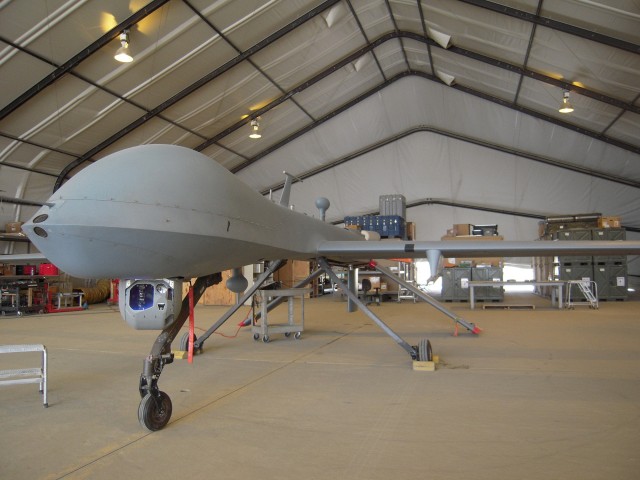
Armed US Predator drones are carrying out missions over Libya, Defence Secretary Robert Gates has said.
Mr Gates said their use had been authorised by President Barack Obama and would give "precision capability" to the military operation.
US drones are already used to target militants along the Pakistan-Afghanistan border.
Libyan rebels have been battling Col Gaddafi's troops since February but have recently made little headway.
"President Obama has said that where we have some unique capabilities, he is willing to use those," Mr Gates told a news conference.
He said two armed, unmanned Predators were being made available to Nato as needed, and marked a "modest contribution" to the military operations.
Mr Gates denied that the drone deployment was evidence of "mission creep" in Libya and said there were still no plans to put US "boots on the ground" in Libya.
"There's no wiggle room in that," he said.
via BBC News - US deploys armed drones over Libya.
Coming Soon From the Air Force: Mind-Reading Drones
Scientifically speaking, it’s only a matter of time before the drones become self-aware and kill us all. Now the Air Force is hastening that day of reckoning.
Buried within a seemingly innocuous list of the Air Force’s recent contract awards to small businesses are details of plans for robot planes that not only think, but anticipate the moves of human pilots. And you thought it was just the Navy that was bringing us to the brink of the drone apocalypse.
It all starts with a solution for a legitimate problem. It’s dangerous to fly and land drones at busy terminals. Manned airplanes can collide with drones, which may not be able to make quick course adjustments based on information from air traffic control as swiftly as a human pilot can. And getting air traffic control involved in the drones cuts against the desire for truly autonomous aircraft. What to do?
The answer: design an algorithm that reads people’s minds. Or the next best thing — anticipates a pilot’s reaction to a drone flying too close.
Enter Soar Technologies, a Michigan company that proposes to create something it calls “Explanation, Schemas, and Prediction for Recognition of Intent in the Terminal Area of Operations,” or ESPRIT. It’ll create a “Schema Engine” that uses “memory management, pattern matching, and goal-based reasoning” to infer the intentions of nearby aircraft. Not presuming that every flight will go according to plan, the Schema Engine’s “cognitive explanation mechanism” will help the drone figure out if a pilot is flying erratically or out of control. The Air Force signed a contract with Soar, whose representatives were unreachable for comment, on December 23.
And Soar’s not the only one. California-based Stottler Henke Associates argues that one algorithm won’t get the job done. Its rival proposal, the Intelligent Pilot Intent Analysis System would “represent and execute expert pilot reasoning processes to infer other pilots’ intents in the same way human pilots currently do.” They don’t say how their system will work and they’ve yet to return an inquiry seeking explanation. A different company, Barron Associates, wants to use sensors as well as algorithms to avoid collision.
And Stottler Henke is explicitly thinking about how to weaponize their mind-reading program. “Many of the pilot intent analysis techniques described are also applicable for determining illegal intent and are therefore directly applicable to finding terrorists and smugglers,” it told the Air Force. Boom: deal inked on January 7. ...
via Coming Soon From the Air Force: Mind-Reading Drones « P3air.
Thursday, April 14, 2011
Wisconsin Man finds live missile in bathroom wall
A week after she and her husband found a live bomb from the Korean War era in a bathroom wall of their home, St. Francis resident Sally Ann Wittman says the discovery now seems almost unreal.
Wittman’s 70-year-old husband, William, was doing some remodeling on a portion of the bathroom wall on April 5. Wittman was pulling out old insulation when he felt something in the wall, his wife said.
“I heard him say, ‘Oh my God, what the heck is this?’” Sally Ann, 60, said. “I walked in, and he was standing there with this thing in his hands.”
The small green missile, measuring 20 inches long with a 5-inch explosive head and four tail fins, was handed to her by her husband, then she walked outside and placed it on the grass next to a detached garage before calling police.
As she waited for police to arrive, Sally Ann said she was doing dishes in the kitchen when she saw a St. Francis police officer approach her yard in the 2000 block of East Leroy Avenue with extreme caution. The officer advised the Wittmans in no uncertain terms to evacuate the house immediately, as well as people living in the surrounding neighborhood.
With streets cordoned off in the residential area west of the Lake Parkway, it took a bomb squad from the Milwaukee County Sheriff’s Department two hours to arrive. The bomb was taken to the St. Francis Department of Public Works, where it was safely detonated. The blast was heard all over town.
“One person told me that when she heard the blast, her son came running out to see where it was coming from,” Wittman said. A salesman I talked to who was making a sale on the corner of Whitnall and Pennsylvania said he heard the blast five blocks away. It was loud enough like ‘What was that?’”
Another woman told Wittman that her mother, who was in Europe during World War II, had a flashback when she heard the blast. “When it went off, I started to tear up,” said Wittman, who works for the Catholic Herald. “It was just (feeling) like this could have been so much more serious.”
Wittman said when she set the bomb down on the grass, it happened to be pointing west, directly at the house of a neighbor who has a 1-1/2-year old toddler.
A neighbor told Sally Ann Wittman that the previous owner of the house was a World War II veteran, and that his sons also served in the Korean War.
“This neighbor told us they used to bring souvenirs back from the war, and they shared it and gave other neighbors stuff,” she said. “They had an old shell that was used to hold a door open.”
via St. Francis man finds live missile in bathroom wall - StFrancisNOW.

Tuesday, April 12, 2011
Terrorists Using Online Games Undetected by CIA and NSA
A cartoon style World War 2 era action shooter game. Customize your character, join a faction and enter the fray. (100 most popular free on line games)
Despite billions of dollars spent by intelligence agencies like NSA and CIA on technologies to intercept and monitor electronic messages and communications, terrorists all over the world are able to communicate without fear of discovery, using online computer games.
The CIA tentatively acknowledged this threat in its 2008 Data Mining Report and started the Reynard Project as a "seedling effort" to detect suspicious behaviour and actions in the virtual world. Although online gaming has exploded and hundreds of millions of people participate in these games, not much has been heard about the Reynard Project since.
Recently the danger of terrorists using computer games as a secure communication channel led to alarming news articles by major newspapers in Europe, following the release of the technothriller MMORPG: How a computer game becomes deadly serious.
Dutchman Emile van Veen spent two years researching how terrorists could utilise so called Massively Multiplayer Online Role Playing Games (MMORPGs). These online games appear to be an unbreakable code for intelligence agencies and offer communication channels like email, chat and voice chat. They are violent by nature, making it virtually impossible to detect dangerous conversations. They can be accessed from any computer, anywhere, by using anonymous accounts. Van Veen's story is set in both the real and the virtual world, a novel concept in itself. Emile van Veen: "Especially reproductions of our real world are dangerous. Someone who wants to blow up the Brooklyn Bridge could examine the target in detail and scout his way in and out as well." He thinks the danger is imminent.
After the release of his thriller in Europe, Van Veen received a lot of worried press attention. "Many people accused me of bringing this to the attention of terrorists and criminals. That's unfair, it's already there. The Intelligence Community must act and they must act fast. I hope my novel helps in bringing about a sense of urgency," he says.
http://www.emilevanveen.com
via Terrorists Using Online Games Undetected by CIA and NSA -- SCHIEDAM, Netherlands and NEW YORK, April 12, 2011 /PRNewswire/ --.

Afghanistan: Drone missile 'killed two US soldiers'
A drone missile strike is suspected of killing two US soldiers by mistake in southern Afghanistan last week, US military officials have said.
The apparent case of "friendly fire" is being investigated - if it is confirmed it would be a rare instance of pilotless aircraft killing US forces.
The incident took place in Helmand province where US-led troops are trying to push back Taliban insurgents.
US drones frequently target suspected militants in Afghanistan and Pakistan.
Critics say hundreds of civilians have also been killed in such strikes in recent years.
The two US soldiers who lost their lives - sergeant Jeremy Smith, 26, and seaman Benjamin Rast, 23 - were part of a unit sent to reinforce marines coming under heavy fire from insurgents outside the town of Sangin, US network NBC News, which first reported the incident, said.
The marines, who were watching a video feed from the armed Predator drone overhead, saw infrared images moving towards them on the feed and may have concluded that those were insurgents instead of fellow marines, NBC reported.
The Pentagon has yet to comment on the deaths, saying they are being investigated. ...
via BBC News - Afghanistan: Drone missile 'killed two US soldiers'.
Let's get to the point where everyone fights wars using robots and drones. And once your machines are defeated, the war is over. No more blowing real people to bits.
Monday, April 11, 2011
Pakistan Tells CIA to Halt Drone Strikes
Pakistan has privately demanded the Central Intelligence Agency suspend drone strikes against militants on its territory, one of the U.S.'s most effective weapons against al Qaeda and Taliban leaders, officials said.
Pakistan has also asked the U.S. to reduce the number of U.S. intelligence and Special Operations personnel in the country, according to U.S. and Pakistani officials.
The U.S. strategy in the war in Afghanistan hinges on going after militants taking refuge in Pakistan. The breakdown in intelligence cooperation has cast a pall over U.S.-Pakistani relations, with some officials in both countries saying intelligence ties are at their lowest point since the Sept. 11, 2001, attacks spurred the alliance.
Beyond the Afghan battlefield, officials believe that without a robust counterterrorism relationship with Pakistan, al Qaeda and other groups can operate with far greater impunity when planning attacks on the U.S. and Europe. The vast majority of attacks against the West in the last decade originated in Pakistan.
Relations have been under heightened strain since Pakistan's arrest in January of CIA contractor Raymond Davis, who was jailed after killing two armed Pakistani men in Lahore on Jan. 27. Mr. Davis was released last month, but the case fueled Pakistani resentment over the presence of U.S. operatives in their country.
Pakistani officials complained that Mr. Davis and potentially dozens of other CIA operatives were working without Islamabad's full knowledge.
Drone strikes are opposed by an overwhelming majority of Pakistanis, and are widely seen as a violation of Pakistan's sovereignty. ...
via Pakistan Tells CIA to Halt Drone Strikes - WSJ.com.
Navy Phasers on Kill: Navy Uses Laser to Cripple Ship in First Sea Test
Northrop Grumman and the U.S. Navy hope to use similar lasers against small aerial targets and unarmored boats in the near future.
United States Navy ships each year face many threats. While large threats mandate heavy munitions or rockets, the majority of threats are from small motorboats with armed occupants. Dealing with these threats is tricky -- larger munitions are potentially lethal and expensive. But using smaller munitions places the ship's crew at risk. Thus the non-lethal accuracy of a laser weapon would be a highly desirable tool for the U.S. maritime warriors.
Sailors' dreams of having such a weapon at their disposal advanced a step forward to reality, with NorthropGrumman Corp. (NOC) and the U.S. Office of Naval Research (ONR) completing the first live test [press release] of a solid state weapon laser at sea.The laser strikes the engine of the moving motorboat.
On fire the ship is now crippled as it is struck by four foot waves.
On Wednesday the USS Paul Foster, a decommissioned destroyer, was retrofitted with Northrop Grumman's 15-kilowatt solid-state high-energy laser (HEL) prototype. The laser creates a high-energy burst of light by running electrons through specially designed pieces of glass or crystals.
The eventual goal of the $98M USD Maritime Laser Demonstrator (MLD) is to install 100-kilowatt lasers on ships. But the smaller 15-kilowatt system proved it might be sufficiently deadly for some applications.
Motoring into the U.S.'s Pacific testing range near San Nicholas Island off the coast of central California, the ship set its aim at a large inflatable motorboat, moving a mile away. Firing a pulse of light, the experimental laser struck a crippling blow damaging the engines and setting them on fire. The target was crippled, floating dead in the ocean. ...
via DailyTech - Navy Uses Laser to Cripple Ship in First Sea Test.

Don't worry, it could never be used against a human target. There are moisture detectors that shut it off if it gets too close and risks burning someone alive. :-/
Sunday, April 3, 2011
HMS Vengeance nuclear sub returns home after power loss
A nuclear-powered submarine is returning to port after a mechanical problem caused loss of power while it was on a training exercise.
HMS Vengeance is returning to Faslane under its own power on the sea surface despite a reduction in propulsion.
The incident happened on Thursday night while the vessel, which is one of four nuclear-powered Vanguard class submarines, was in the North Atlantic.
An MoD spokesman said the incident was "not nuclear related".
He said: "Vengeance has suffered a mechanical defect resulting in a reduction in propulsion.
"She is returning to Faslane under her own power."
John Large, a consultant on nuclear safety, said the most likely cause of the failure would be discarded fishing nets or heavy mooring cables.
He said the submarines were designed to disengage their engines and "dump" power in the event of a propeller unit becoming jammed.
The boat carries up to 48 nuclear warheads on up to 16 Trident missiles, which weigh 60 tonnes and have a range of 4,000 nautical miles.The submarine also carries conventional Spearfish torpedoes.
One of the four submarines, which together comprise Britain's nuclear deterrence, is always on patrol as an "insurance policy" known as Continuous At Sea Deterrence. ...
via BBC News - HMS Vengeance nuclear sub returns home after power loss.
Isn't a sub with 48 nuclear warheads insane? If it is just a deterrence, I recommend fake warheads. These save money and make the ocean safer. Fake subs would be great too.
"Warning to All Nations: The Great British Navy has added a large number of new highly dangerous smooth black nuclear submarines each with 62 or more very deadly warheads of the completely nuclear type. The HMS Vengeance will be joined by these 62 new ships spear headed by a trio of command subs: the HMS Freakyouout, the HMS Messyouup, and the HMS Unsurivabledisaster.
Monday, March 28, 2011
New idea: Figh terrorists with curry powder (a cheap sensor for explosives)
- The main chemical in the curry spice turmeric could be the basis for cheap explosives detectors, say researchers.
The curcumin molecule is already well-known in medicine for its anti-cancer and anti-oxidant properties.
Now, research presented at the American Physical Society meeting suggests it could replace more complex solutions to spot explosives like TNT.
As it gathers molecules of explosive material in air, changes in its light-emitting properties can be measured.
This "fluorescence spectroscopy" is already employed in a wide array of sensing and analysis techniques.
Illuminating some chemicals causes them to re-emit light of a different colour, sometimes for extended periods - an effect exploited in, for example, glow-in-the-dark materials.
The intensity of this re-emitted light can change if different molecules bind to the fluorescent ones, and that is how sensing techniques exploit the effect. ...
via BBC News - Curry powder molecule 'is cheap sensor for explosives'.
Saturday, March 26, 2011
Outrageous Military Experiment: Modifying humans to see infrared
This is taken from an article titled The 7 Most Outrageous Military Experiments. I would not say that these are really the 7 most outrageous, but the one below is interesting and I hadn't heard of it before:
Here is a PDF article from July 1939 on wall eyed pike liver oil's special properties.
The U.S. Navy wanted to boost sailors' night vision so they could spot infrared signal lights during World War II. However, infrared wavelengths are normally beyond the sensitivity of human eyes. Scientists knew vitamin A contained part of a specialized light-sensitive molecule in the eye's receptors, and wondered if an alternate form of vitamin A could promote different light sensitivity in the eye. They fed volunteers supplements made from the livers of walleyed pikes, and the volunteers' vision began changing over several months to extend into the infrared region. Such early success went down the drain after other researchers developed an electronic snooperscope to see infrared, and the human study was abandoned. Other nations also played with vitamin A during World War II – Japan fed its pilots a preparation that boosted vitamin A absorption, and saw their night vision improve by 100 percent in some cases.
via The 7 Most Outrageous Military Experiments | 7CoolList.
Here is a PDF article from July 1939 on wall eyed pike liver oil's special properties.
A Nuclear Cannon
YouTube - NUCLEAR CANNON.
Nuclear artillery is a subset of limited-yield tactical nuclear weapons, in particular those weapons that are launched from the ground at battlefield targets. Nuclear artillery is commonly associated with shells delivered by a cannon, but in a technical sense short-range rockets or missiles are also included.
The development of nuclear artillery was part of a broad push by nuclear weapons countries to develop nuclear weapons which could be used tactically against enemy armies in the field (as opposed to strategic uses against cities, military bases, and heavy industry). Nuclear artillery was both developed and deployed by a small group of nations, including the USA, USSR, and France. The United Kingdom planned and partially developed such weapon systems (the Blue water missile and the Yellow Anvil artillery shell) but did not put these systems into production. ...
Nowadays, nuclear artillery has almost been replaced with mobile tactical ballistic missile launchers carrying missiles with nuclear warheads. However, some countries, such as China, India and Pakistan (and there is a rumor that North Korea is capable of using nuclear artillery), are still using nuclear artillery as an alternative method derived from conventional ballistic missiles.
via wikipedia
A Nuclear Cannon
YouTube - NUCLEAR CANNON.Nuclear artillery is a subset of limited-yield tactical nuclear weapons, in particular those weapons that are launched from the ground at battlefield targets. Nuclear artillery is commonly associated with shells delivered by a cannon, but in a technical sense short-range rockets or missiles are also included.
The development of nuclear artillery was part of a broad push by nuclear weapons countries to develop nuclear weapons which could be used tactically against enemy armies in the field (as opposed to strategic uses against cities, military bases, and heavy industry). Nuclear artillery was both developed and deployed by a small group of nations, including the USA, USSR, and France. The United Kingdom planned and partially developed such weapon systems (the Blue water missile and the Yellow Anvil artillery shell) but did not put these systems into production. ...
Nowadays, nuclear artillery has almost been replaced with mobile tactical ballistic missile launchers carrying missiles with nuclear warheads. However, some countries, such as China, India and Pakistan (and there is a rumor that North Korea is capable of using nuclear artillery), are still using nuclear artillery as an alternative method derived from conventional ballistic missiles.
via wikipedia

Monday, March 21, 2011
U.S. Military Deploys Gunfire Detection System
A new warfighting technology will soon be making its way to Afghanistan. U.S. Army forces will be getting gunshot detection systems, which can tell where a shot was fired from.
Approximately 13,000 gunshot detection systems will be given to individual footsoldiers later this month, according to the U.S. Army. The system, called Individual Gunshot Detector (IDG), is made by Reston, Va.-based QinetiQ North America.
IDG has four small acoustic sensors and a small display screen attached to the soldier's body armor that shows the distance and direction of incoming bullets. The sensors are each about the size of a deck of cards and can detect the supersonic sound waves generated by enemy gunfire. It alerts the soldier of the shot's direction in less than one second.
"We're really trying to ensure that every Soldier is protected," said Brigadier General Peter Fuller, program executive officer soldier, said in a statement. "When you get fired on, instead of trying to figure everything out, you will have technology to assist you in knowing what happened and where the shot was coming from."
One of the system's advantages, according to the Army and QinetiQ, is the fact it's very light, weighing less than two pounds. This allows the army to strategically disperse the systems throughout small, dismounted units and thus get maximum protection for platoons, squads and other units on the move.
Lt. Colonel Chris Schneider says the Army plans to field up to 1,500 gun detectors per month. The Army plans on integrating the gun detection system with its Land Warrior and Nett Warrior systems. These systems include a GPS digital-mapping-display technology, a radio, a helmet-mounted display and a hand-held data input device, allowing soldiers to have "unparalleled situational awareness." ...
via U.S. Military Deploys Gunfire Detection System - International Business Times.

Saturday, March 19, 2011
U.S. and British ships and submarines fire missiles, Libyan jet shot down over Benghazi
YouTube - Libyan jet shot down over Benghazi.... Gadhafi, who has ruled Libya for 41 years, said in a telephone call to Libyan state TV that he was opening weapons depots to allow his people to arm themselves in defense.
He said the international action against his forces was unjustified, calling it "simply a colonial crusader aggression that may ignite another large-scale crusader war." He warned that the involvement of international forces will subject the Mediterranean and North African region to danger.
President Obama authorized limited military action against Libya. He reiterated that he would not send American ground troops.
"We cannot stand idly by when a tyrant tells his people there will be no mercy," Obama said Saturday from Brazil.
U.S. and British ships and submarines fired more than 110 cruise missiles at more than 20 Libyan air defense targets, Vice Adm. William Gortney, director of the Joint Staff, told reporters on Saturday. Most of those areas are in and around the capital Tripoli.
The first Tomahawk cruise missiles struck at 3 p.m. ET, Gortney said, after a one-hour flight from U.S. and British vessels in the Mediterranean.
No U.S. aircraft fired missiles or dropped bombs, Gortney said.
The British defense secretary, Liam Fox, said in a statement that Tornado GR4 fast jets flew 3,000 miles from Royal Air Force Station Marham in Norfolk, England, and back. The jets launched Stormshadow missiles, while a Trafalgar submarine launched Tomahawk cruise missiles. ...
via USAToday
I watched Battle Los Angeles tonight. The story wasn't much about the aliens invading so much as the fighting. It stuck me as full length advertisement for the U.S. Marines. Who were the aliens in the movie? Did they have eyes? How could water power their technology? Where did they come from? What did they want? Did they have a leader? What did they eat? Don't expect to find out if you pay to see this movie.
Meanwhile, I'm starting to wonder if we are on the brink of even more real war. To top it off, it's a hellish night. The wind is howling and banging things around my home. It is the night of the supermoon. The wind is furious. The power just flickered out, and back on. How long will it last?
Friday, March 18, 2011
Naval sonar exercises linked to whale strandings, according to new report
Scientists have long been aware of a link between naval sonar exercises and unusual mass strandings of beaked whales. Evidence of such a link triggered a series of lawsuits in which environmental groups sued the U.S. Navy to limit sonar exercises to reduce risk to whales. In 2008, this conflict rose to the level of the US Supreme Court which had to balance potential threat to whales from sonar against the military risk posed by naval forces inadequately trained to use sonar to detect enemy submarines. The court ruled that the Navy could continue training, but that it was essential for the Navy to develop better methods to protect the whales.
The knowledge most critical to protecting these whales from risk of sonar involves measuring the threshold between safe and risky exposure levels, but until now it has not been known how beaked whales respond to sonar, much less the levels that pose a problem. "We know so little about beaked whales because they prefer deep waters far offshore, where they can dive on one breath of air to depths of over a mile for up to an hour and a half," said Peter Tyack, a senior scientist at Woods Hole Oceanographic Institution (WHOI).
Now, an international team of researchers reports in a paper led by Tyack the first data on how beaked whales respond to naval sonar exercises. Their results suggest that sonar indeed affects the behavior and movement of whales.
Tyack and his colleagues used two complementary methods to investigate behavioral responses of beaked whales to sonar: "an opportunistic approach that monitored whale responses to multi-day naval exercises involving tactical mid-frequency sonars, and an experimental approach using playbacks of simulated sonar and control sounds to whales tagged with a device that records sound, movement, and orientation," the researchers report in the current issue of the online journal PLoS ONE, published by the Public Library of Science.
That research team developed experiments to slowly increase the level of sonar at a tagged whale, to stop exposure as soon as the whale started responding, to measure that exposure, and to define the response. The experimental approach used tags to measure acoustic exposure and behavioral reactions of beaked whales to one controlled exposure each of simulated military sonar, killer whale calls, and band-limited noise.
"These experiments were very difficult to develop, and it was a major breakthrough simply to be able to develop a study that could safely study these responses," Tyack said. "All three times that tagged beaked whales were exposed experimentally to playback of sounds when they were foraging at depth, they stopped foraging prematurely and made unusually long and slow ascents to the surface, moving away from the sound.
Beaked whales use their own biosonar to find prey when they are foraging; this means that one can monitor cessation of foraging by listening for when they stop clicking. Once the researchers found that beaked whales responded to sonar by ceasing clicking, they were able to monitor reactions of beaked whales during actual sonar exercises on the range. The research was conducted on a naval testing range where an array of underwater microphones, or hydrophones, covered the seafloor, allowing whale sounds to be monitored over 600 square miles. "During actual sonar exercises, beaked whales were primarily detected near the periphery of the range, on average 16 km away from the sonar transmissions. Once the exercise stopped, beaked whales gradually filled in the center of the range over 2-3 days," they report. ...
via Naval sonar exercises linked to whale strandings, according to new report.
Tuesday, March 8, 2011
New 9/11 helicopter video of Twin Towers released
New video has emerged of the 11 September 2001 attacks on New York's World Trade Center, shot by a police helicopter crew hoping in vain to rescue trapped office workers.
The video shows the aircraft hovering near the towers' roofs, only to retreat as the first tower fell.
"The whole tower, it's gone," an officer is heard yelling. "They knocked the whole fricking thing down."
It was released by a US government agency that investigated the collapse.
The airspace over the towers was closed to news helicopters on the morning of the attacks, so little video of the attacks from the air has emerged.
The National Institute of Standards and Technology obtained the video from the New York Police Department during its investigation into the structural collapse of the Twin Towers.
It was released by the NIST in response to a Freedom of Information Act request, but it was not clear who published it online.
More than 2,800 people were killed when hijackers crashed jets into the buildings.
The same morning, more were killed when hijackers crashed a jet into the Pentagon just outside Washington DC, and in Shanksville, Pennsylvania, where hijackers flew a jet into the ground as passengers fought their way into the aircraft cabin in a bid to retake the plane.
via BBC News - New 9/11 helicopter video of Twin Towers released.
Monday, March 7, 2011
Darpa’s Cheetah-Bot Designed to Chase Human Prey
Perhaps you thought the four-legged BigDog robot wasn’t eerily lifelike enough. That’ll change soon. BigDog’s makers are working on a new quadruped that moves faster than any human and is agile enough to “chase and evade.”
Boston Dynamics, maker of the Army’s BigDog robotic mule, announced today that Darpa has awarded it a contract to build a much faster and more fearsome animal-like robot, Cheetah.
As the name implies, Cheetah is designed to be a four-legged robot with a flexible spine and articulated head (and potentially a tail) that runs faster than the fastest human. In addition to raw speed, Cheetah’s makers promise that it will have the agility to make tight turns so that it can “zigzag to chase and evade” and be able to stop on a dime.
Cheetah builds off work on the company’s previous four legged animal bot, BigDog. It was built as a kind of unmanned pack mule, designed to carry equipment for troops on the battlefield. The robotic donkey could carry 300 lbs. over 13 miles on flat ground, take a swift kick and keep on moving. It’s creepy, lifelike movement can be seen on a number of videos online, climbing over hills and snow and hiking alongside soldiers, using GPS coordinates as its waypoints.
via Darpa’s Cheetah-Bot Designed to Chase Human Prey | Danger Room | Wired.com.

I have one word for you if you are being chased by this bad boy... bolas. Even if it comes equipped with line cutters to get itself free, three trained humans with bolas (which are very cheap to make, by the way) could take it down. Of course, you have to have know the thing is hunting you to be prepared. Not sure what it is supposed to do when it catches you. Does it eat you? Explode? Leap upon you?
Subscribe to:
Posts (Atom)