A new book claims Africa could feed itself within a generation, and become a major agricultural exporter.
The book, The New Harvest, by Harvard University professor Calestous Juma, calls on African leaders to make agricultural expansion central to all decision-making.
Improvements in infrastructure, mechanisation and GM crops could vastly increase production, he claims.
The findings are being presented to African leaders in Tanzania today.
The presidents of Tanzania, Kenya, Uganda, Rwanda and Burundi are holding an informal summit to discuss African food security and climate change.
Speaking to the BBC ahead of the meeting, Professor Juma said African leaders had to recognise that "agriculture and economy for Africa are one and the same".
"It is the responsibility of an African president to modernise the economy and that means essentially starting with the modernisation of agriculture," he said. ...
via BBC News - Africa 'can feed itself in a generation'.
Friday, December 3, 2010
Africa 'can feed itself in a generation'


US-Japan naval drills start as N Korea tensions rise
Japan and the United States have begun their biggest ever joint military exercises, amid growing tension in the region between North and South Korea.
More than 44,000 Japanese and American military personnel are taking part in the drill off Japan's southern islands.
Forty Japanese and 20 US warships are also involved, as are hundreds of military aircraft.
The exercises come 10 days after North Korea shelled a South Korean island, killing four people.
South Korean observers are present for the first time. ...
The joint military exercises - codenamed Keen Sword - are being held to mark the 50th anniversary of the US-Japan alliance.
They are intended to be a show of solidarity between the Pacific allies at a time of heightened tension in the region, says the BBC's Roland Buerk in Tokyo.
The drills were planned well before North Korea shelled the South Korean island of Yeonpyeong last month, killing two marines and two civilians.
But they come just days after the United States and South Korea carried out their own joint military exercises, putting on a show of force in the Yellow Sea.
US Secretary of State Hillary Clinton said North Korea remained "an immediate threat to the region around it, particularly to South Korea and Japan".
North Korea also posed "a medium-term threat, should it collapse, to China", she said.
Beijing has criticised the manoeuvres and called for more talks with Pyongyang, saying it is better to negotiate than "brandish weapons".
Japan's government has been on high alert since North Korea shelled the island of Yeonpyeong on 23 November, killing at least four South Koreans. ...
via BBC News - US-Japan naval drills start as N Korea tensions rise.
Thursday, December 2, 2010
Save Apps from iPhone to iTunes (How to)
I don't want iTunes on my computer, but Apple pretty much demands it if you have an iPhone and want to back it up, upgrade your firmware, etc.
So, here's what I do. Set up my system without iTunes. Make a disk image with Clonezilla (free), then install iTunes to do a back up once a month. When I want to get rid of iTunes (which adds 740 MB to my system after I back up my iPhone) I just restore the image of my computer without the iTunes junk back to my system.
Anyway, backing up a bit, after I install iTunes for the first time, when I plug in my iPhone, the sync does not include my apps. If I try to sync, a prompt tells my I'm about to wipe out all my data in my apps.
Here's how to do it right:
PS. In case you don't realize how cool Clonezilla (free) is, you can spend weeks getting your system set up just the way you want, all the software, all the settings, all the plug-ins, fonts, anti-virus, firewall, then get rid of excess Windows files and other junk (be careful), and then ... make an image of your perfectly tuned system.
To make the image, you have to get the Clonezilla ISO file, burn it to a CD, boot your system to the CD, follow the prompts, plug in your USB drive, answer some more prompts and then save the image of your computer HD to your USB drive. It takes about 10 minutes for me.
Now you can try experimental software. If you get a virus or suspect spyware, you can get your entire system back fresh with a Clonezilla restore in a few minutes ... usually half the time it takes you to make the image. You can even do this starting from a completely blank hard drive if your drive dies. This is a 100 times faster than re-installing Windows and setting everything up again just right.
If you just want a good uninstaller for Windows that is free and removes all traces of software you install from your system, try Revo Uninstaller (free).
I got my entire speedy little Windows XP set up down to one 3.3 GB image - That's all of my music, pdf book library, software, etc... and it all fits on a Kingston USB DataTraveler G3 drive ($6.95). Another tip: On that one image, you can also have encrypted files with your financial information using a program like TrueCrypt.
Perhaps no one can win the privacy battle, but you can at least go down fighting.
So, here's what I do. Set up my system without iTunes. Make a disk image with Clonezilla (free), then install iTunes to do a back up once a month. When I want to get rid of iTunes (which adds 740 MB to my system after I back up my iPhone) I just restore the image of my computer without the iTunes junk back to my system.
Anyway, backing up a bit, after I install iTunes for the first time, when I plug in my iPhone, the sync does not include my apps. If I try to sync, a prompt tells my I'm about to wipe out all my data in my apps.
Here's how to do it right:
- Open iTunes.
- On the menu bar, across the top left, click on Edit.
- Go to the bottom of the list and click on Preferences.
- In the pop-up box, click on the Devices tab.
- Check the box beside the words: Prevent iPods, iPhones, and iPads from syncing automatically.
- Connect the iPhone to the computer.
- Once the iPhone appears on the left panel of iTunes, right click.
- Click on Transfer Purchases.
Anything on the iPhone that was downloaded from iTunes should be transferring to your computer.
- Now to sync your iPhone, bring it up in iTunes and click sync at the bottom right of the screen, or go back into Preferences and turn back on automatic syncing.
via HOW TO SAVE EXISTING IPHONE APPLICATIONS [Solved].
PS. In case you don't realize how cool Clonezilla (free) is, you can spend weeks getting your system set up just the way you want, all the software, all the settings, all the plug-ins, fonts, anti-virus, firewall, then get rid of excess Windows files and other junk (be careful), and then ... make an image of your perfectly tuned system.
To make the image, you have to get the Clonezilla ISO file, burn it to a CD, boot your system to the CD, follow the prompts, plug in your USB drive, answer some more prompts and then save the image of your computer HD to your USB drive. It takes about 10 minutes for me.
Now you can try experimental software. If you get a virus or suspect spyware, you can get your entire system back fresh with a Clonezilla restore in a few minutes ... usually half the time it takes you to make the image. You can even do this starting from a completely blank hard drive if your drive dies. This is a 100 times faster than re-installing Windows and setting everything up again just right.
If you just want a good uninstaller for Windows that is free and removes all traces of software you install from your system, try Revo Uninstaller (free).
I got my entire speedy little Windows XP set up down to one 3.3 GB image - That's all of my music, pdf book library, software, etc... and it all fits on a Kingston USB DataTraveler G3 drive ($6.95). Another tip: On that one image, you can also have encrypted files with your financial information using a program like TrueCrypt.
Perhaps no one can win the privacy battle, but you can at least go down fighting.
Race Is On to 'Fingerprint' Phones, PCs
David Norris wants to collect the digital equivalent of fingerprints from every computer, cellphone and TV set-top box in the world.
He's off to a good start. So far, Mr. Norris's start-up company, BlueCava Inc., has identified 200 million devices. By the end of next year, BlueCava says it expects to have cataloged one billion of the world's estimated 10 billion devices.
Advertisers no longer want to just buy ads. They want to buy access to specific people. So, Mr. Norris is building a "credit bureau for devices" in which every computer or cellphone will have a "reputation" based on its user's online behavior, shopping habits and demographics. He plans to sell this information to advertisers willing to pay top dollar for granular data about people's interests and activities.
Device fingerprinting is a powerful emerging tool in this trade. It's "the next generation of online advertising," Mr. Norris says.
It might seem that one computer is pretty much like any other. Far from it: Each has a different clock setting, different fonts, different software and many other characteristics that make it unique. Every time a typical computer goes online, it broadcasts hundreds of such details as a calling card to other computers it communicates with. Tracking companies can use this data to uniquely identify computers, cellphones and other devices, and then build profiles of the people who use them. ...
via Race Is On to 'Fingerprint' Phones, PCs - WSJ.com.
Forget cookies--even the ultrasneaky, Flash-based "super cookies." A new type of tracking may identify you far more accurately than any cookie--and you may never know it was there.The method pulls together innocuous data about your browser, such as plug-ins, system fonts, and your operating system. Alone, they don't identify you. Together, they're a digital fingerprint.
It's like describing a person. Just saying "brown hair" won't identify anyone. But add in "5 feet, 10 inches tall," "chipped right front tooth," "size 12 shoes," and so on, and soon you have enough information to pull someone out of a crowd, even without their name, Social Security number, or any other of the usual identifiers.
Test your browser for unique identifiers without the risk: The Electronic Frontier Foundation, a privacy advocacy group, has set up an interesting online experiment at Panopticlick.eff.org. Panopticlick gathers little details about your browser and computer, mostly using Javascript. In my case, the information it gathered about my browser was enough to uniquely identify my surfing software out of more than 650,000 visitors.
via PC World
So, your browser is reporting: fonts you have installed, in what order they were installed, your clock setting down to the millisecond, your browser plug-ins, type of web browser, MAC address ... you can mess with most of this stuff with privacy software and running plane jane configurations.
Firefox test: No privacy browsing: "only one in 641,436 browsers have the same fingerprint as yours."
Firefox's Privacy browsing: ...
Julian Assange, Wanted Whistleblower
A whistleblower is a person who raises a concern about alleged wrongdoing occurring in an organization or body of people. ... Whistleblowers may make their allegations internally (for example, to other people within the accused organization) or externally (to regulators, law enforcement agencies, to the media or to groups concerned with the issues).
Whistleblowers frequently face reprisal, sometimes at the hands of the organization or group which they have accused, sometimes from related organizations, and sometimes under law. ...
...in the United States, most whistleblower protection laws provide for limited "make whole" remedies or damages for employment losses if whistleblower retaliation is proven. However, many whistleblowers report there exists a widespread "shoot the messenger" mentality by corporations or government agencies accused of misconduct and in some cases whistleblowers have been subjected to criminal prosecution in reprisal for reporting wrongdoing. ...
via Whistleblower - Wikipedia, the free encyclopedia.
I've been saying for years that the Government wants to make it a crime to know about their crimes. That, being able to rob people and get away with it, is the main reason politicians want control of the Internet, a kill switch for the Internet, warrant-less searches, and the ability to spy on everyone.
If not for Wikileaks, we would not know that the U.S. has been secretly bombing Yemen.
If Wikileaks gets this stuff, I don't see why they don't just go through the information carefully and just release the most damning parts and require investigations into crimes revealed. Perhaps they tried that and it didn't work, so they took it up to the next level.
Assange doesn't seem to be doing this just to disrupt things. I don't see him as an anarchist or a terrorist. He is a zealot of information freedom, but his interest in disclosing wrongdoing seems very clear. In the long run, I think that may be what we need right now. Make democracy more than a buzzword.
If they take Assange out, a thousand more could take his place in protest. Even if they don't, the information already released will reverberate for decades.
WikiLeaks founder Julian Assange: Has US already indicted him?
WikiLeaks Founder Julian Assange Tells TIME: Hillary Clinton 'Should Resign'
Julian Assange's Next WikiLeak Will Reportedly Expose Wall Street
How the US media is dumping on WikiLeaks - and censoring the cable disclosures
WikiLeaks cables on Afghanistan show monumental corruption
Hundreds of U.S. diplomatic cables obtained by WikiLeaks paint a picture of corruption in Afghanistan at every level of government and society, according to the New York Times and the Guardian newspaper in London.
The New York Times, reporting the scale of the problem, said the documents showed corruption's " pervasive nature, its overwhelming scale, and the dispiriting challenge it poses to American officials."
One cable from the U.S. mission in Kabul earlier this year noted that the agriculture minister, Asif Rahimi, "appears to be the only minister that was confirmed about whom no allegations of bribery exist."
Two months previously, a senior Afghan minister warned U.S. diplomats that President Hamid Karzai was "under great pressure from political leaders to accept a number of ministerial candidates whose technical skills are lacking." The minister "argued that these political leaders are only thinking of dividing up the spoils rather than the quality of government needed to tackle Afghanistan's problems." He also told the U.S. Embassy that of the $200 million collected in fees on truck traffic, just $30 million reached government coffers. ...
via WikiLeaks cables on Afghanistan show monumental corruption - CNN.com.

Triple That Vitamin D Intake, Panel Prescribes
MELINDA BECK - A long-awaited report from the Institute of Medicine to be released Tuesday triples the recommended amount of vitamin D most Americans should take every day to 600 international units from 200 IUs set in 1997.
That's far lower than many doctors and major medical groups have been advocating—and it could dampen some of the enthusiasm that's been building for the sunshine vitamin in recent years.
Many doctors have added blood tests of vitamin D levels to annual physicals, and sales of vitamin D supplements have soared to $425 million last year from $40 million in 2001, according to the Nutrition Business Journal.
It's long been known that vitamin D is essential to maintaining strong bones. But hundreds of new studies have also linked low vitamin D levels to a higher risk of a slew of chronic health problems—heart disease, stroke, diabetes, prostate, breast and colon cancers, auto-immune diseases, infections, depression and cognitive decline. Studies have also suggested that many Americans are vitamin D deficient due to working and playing indoors and slathering on sunscreen.
The Institute of Medicine, an arm of the National Academy of Sciences that sets governmental nutrient levels, said there wasn't enough evidence to prove that low vitamin D causes such chronic diseases; it based its new recommendations on the levels needed to maintain strong bones alone. ...
The panel also raised the acceptable upper limit of daily intake to 4,000 IUs for adults, from 2,000 previously. ...
The panel was also concerned about what she called "emerging evidence of concern" about possible ill effects of too much vitamin D. Besides a risk of kidney and heart damage noted with vitamin D levels of 10,000 IUs per day, Dr. Brannon said the panel had seen higher death rates from pancreatic cancer, prostate cancer and other causes in men whose blood levels were above 50 ng/ml. The link is still tentative and may never be proven, she noted: "The difficulty is, you can't design a trial to look at adverse effects." ...
He said that despite the paucity of randomized-controlled trials, the long list of chronic diseases associated with vitamin D does make sense, given that it is actually a hormone that affects virtually every organ in the human body and regulates as many as 2,000 genes.
For his part, Dr. Holick recommends that adults take 2,000 to 3,000 IUs per day—and notes that he had done studies giving subjects 50,000 IUs twice a month for six years and seen no harmful effects. "There is no downside to increasing your vitamin D intake, and there are more studies coming out almost on a weekly basis," he said. ...
via Triple That Vitamin D Intake, Panel Prescribes - WSJ.com.
I've been sick for the past few days and yesterday I started taking 2,500 IUs/day of Vitamin D3 from a non-fish liver source.
Computer Game Makes You a Genetic Scientist
A new online game harnesses the computational power of idle brains to help decipher the origins of genetic diseases.
The game, called Phylo, stands on the shoulders of crowdsourced science giants like the protein-folding game Foldit and the celestial object identification powerhouse Galaxy Zoo. Each project takes advantage of humans’ prowess at pattern recognition, something computers are notoriously terrible at.
“There are some tasks that humans can do better than computers, like solving puzzles,” said bioinformatics expert Jerome Waldispuhl of McGill University, one of Phylo’s project leaders. The game was officially launched Nov. 29.
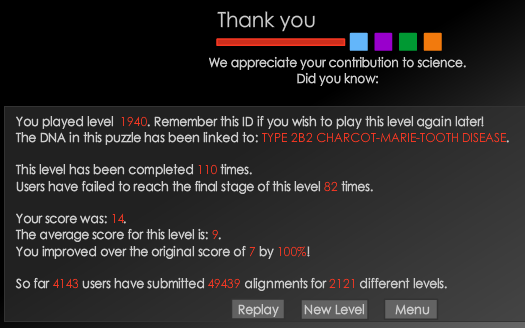
Phylo players move colored squares representing the four nucleotides of DNA to find the best alignment between snippets of DNA from two different species. These particular sections of DNA, called promoter regions, determine which parts of the genome end up as traits in the organism, whether it be blue eyes or heart disease.
Seeing where the genes line up across species can help biologists pinpoint the sources of genetic disorders. ...
Unlike in Foldit or Galaxy Zoo, the science in Phylo is pretty well hidden. It feels like an abstract puzzle game, with colorful shapes and jazzy music. That was deliberate, Waldispuhl says.
“We don’t want to be restricted only to the people interested in science,” he said. Science geeks won’t need as much convincing to play a game that helps research move forward, he says. The Phylo developers want the game to appeal to people who would otherwise play Farmville. ...
via Computer Game Makes You a Genetic Scientist | Wired Science | Wired.com.

You can play Phylo right now. Not quite sure I get it... Ok, push all rows all the way to the left, and then try to match colors, but mostly minimize the number of gaps total. Nice that I would be helping fight a tooth disease. :-)
NASA's Announcement: Arsenic Eating Bacteria Found On Earth, Ramifications for Alien Life
RANDOLPH E. SCHMID - The discovery of a strange bacteria that can use arsenic as one of its nutrients widens the scope for finding new forms of life on Earth and possibly beyond.While researchers discovered the unusual bacteria here on Earth, they say it shows that life has possibilities beyond the major elements that have been considered essential.
"This organism has dual capability. It can grow with either phosphorous or arsenic. That makes it very peculiar, though it falls short of being some form of truly 'alien' life," commented Paul C. W. Davies of Arizona State University, a co-author of the report appearing in Thursday's online edition of the journal Science.
Six major elements have long been considered essential for life – carbon, hydrogen, nitrogen, oxygen, phosphorus and sulfur.
But the researchers found that the bacteria, discovered in Mono Lake, Calif., is able to continue to grow after substituting arsenic for phosphorous. ...
The find is important in the search for life beyond Earth because researchers need to be able to recognize life, to know what life looks like, Anbar said. ...
Felisa Wolfe-Simon of NASA's Astrobiology Institute, who led the study, targeted Mono Lake because it has high arsenic levels.
Arsenic and phosphorous are chemically similar, so she speculated that a microbe exposed to both might be able to substitute one for the other.
"Arsenic is toxic mainly because its chemical behavior is so similar to that of phosphorus. As a result, organisms have a hard time telling these elements apart. But arsenic is different enough that it doesn't work as well as phosphorus, so it gets in there and sort of gums up the works of our biochemical machinery," explained Anbar.
The researchers collected the bacteria known as GFAJ-1 and exposed it to increasing concentrations of arsenic, which it was able to adapt to and grow.
The microbe does grow better on phosphorous, but showing that it can live with arsenic instead raises the possibility that a life form using arsenic could occur naturally, either elsewhere on Earth or on another planet or moon where arsenic is more common. ...
via HuffingtonPost
Further explanation of why this is so "alien".
All living organisms on this planet use six elements for almost all of the chemical structures of DNA, RNA, proteins, and lipids. There is a smattering of other elements, mostly metals, that are essential for biological functions (e.g., the iron in hemoglobin). However, we wouldn’t expect to find anything outside of carbon, hydrogen, oxygen, nitrogen, sulfur and phosphorus in the basic structures of biomolecules. Surprisingly, a team of scientists provide evidence in Science that another element, arsenic, can be incorporated into the basic chemical makeup of the macromolecules of life, replacing some of its phosphorus.
Evolutionary geochemist Felisa Wolfe-Simon, the lead author, and her colleagues found a strain of bacterium (GFAJ-1 of the Halomonadaceae family) that can grow in a medium abundant in arsenic and lacking phosphorus. The GFAJ-1 bacterium naturally resides in the arsenic-rich waters (200 uM) of Mono Lake located in California's Eastern Sierra, and it belongs to a family of proteobacteria that is known to accumulate arsenic. It's not remarkable that GFAJ-1 survives in high concentrations of arsenic, but what is startling is that it potentially integrates arsenic into its DNA and proteins. ...
via ArtsTechnica
Full-Scale Replica Of Noah's Ark Planned For Grant Co.
The Creation Museum will announce details Wednesday afternoon of its planned expansion.
Answers In Genesis, which built and operates the religious-themed attraction, plans to build a full-scale wooden replica of Noah's Ark based on biblical descriptions.
The $24.5 million project will be constructed by the same team that built the Creation Museum.
The religious ministry is soliciting online donations to help construct the project, which they expect to draw an estimated 1.6 million visitors per year.
Ken Ham, president and CEO of Answers In Genesis, cites poll data showing that an estimated 63 percent of Americans would visit a full-scale replica of Noah's Ark if one were built in the U.S.
"We see a full-scale, wooden ark as something so significant that it will shake up this nation," Ham said. "It would be a clear reminder to America about the truths of the Bible. The building of a huge ark is a unique and powerful opportunity to reach millions in our nation (and around the world) with a bold statement: God's word is true." ...
via Full-Scale Replica Of Noah's Ark Planned For Grant Co. - Cincinnati News Story - WLWT Cincinnati.

 Cool. Once they get two of every animal on earth inside I'll go visit. That shouldn't be so difficult, right?
I will establish my covenant with you, and you shall come into the ark, you, your sons, your wife, and your sons’ wives with you. 19And of every living thing of all flesh, you shall bring two of every sort into the ark to keep them alive with you. They shall be male and female. 20Of the birds according to their kinds, and of the animals according to their kinds, of every creeping thing of the ground, according to its kind, two of every sort shall come in to you to keep them alive. 21Also take with you every sort of food that is eaten, and store it up. It shall serve as food for you and for them." 22(P) Noah did this; he did all that God commanded him. - biblegateway
No problem. You get a couple elephants, a couple tigers, a couple goats ... wait ... and two each of the 5,486 other mammal species ... and two each of the 450,000 species of beetles, two each of the 9,084 reptile species, two each of the 102,248 species of spiders and scorpions ... wait, and the 350,000 types of plants, .... and the fugi ... and the birds?! ... and the 447,752 other insect species after you take away the beetles, spiders and scorpions!!!?? ...oh crap... and what about all the fresh water fish species?! Do I have to build fish tanks on the Ark? A "type" of animal is not enough. Unless you agree that evolution of new species took place, you can't just collect one pair from every genera of animal.
Get the point? The task is not actually possible. Unlike the Creation Museum people, Noah and Utnapishtim both had the good sense to protest this absurd idea. Some things are simple for a boss to command, but impossible for a worker to actually do. The devil is in the details.
The 50,000 animals estimate on christianansswers.net is laughable. The number is at least 12 times that. For example, even if we think that the 5,000 aquatic beetle species world-wide could all survive in salt-water, that still leaves 445,000 species of beetles to collect and feed. If you could collect two each of 10 different beetle species per day--they aren't all in once place, you have to hunt for them---, it would take you 45 years to collect them all. Fourty-five years of work and you would only have one kind of animal ... beetles ... on your Ark. Well, if you are 500 to 600 years old already, another 45 years collecting one kind of bug isn't so bad.
But wait, every species has to have the right habitat to survive, some need heat, some need cold, ... and the right kind of food. How do you figure out what food each type of beetle likes to eat?
A whole pack of miracles would be needed: 1) Put the animals into suspended animation so no one has to feed them. 2) change the laws of physics so the boat does not sink under the weight of the rhinos, hippos, etc.3) Make all the predators peaceful so they don't eat the other animals on the way to and from the boat at the start and end.
Adults who take this story literally are embarrassingly ignorant about the real diversity of life on earth.
Why not do something more Christian? $24.5 million could feed a lot of hungry people.
Scientists Find 200 Sextillion More Stars in the Sky
The night sky may be a lot starrier than we thought.
A study suggests the universe could have triple the number of stars scientists previously calculated. For those of you counting at home, the new estimate is 300,000,000,000,000,000,000,000. That's 300 sextillion.
The study questions a key assumption that astronomers often use: that most galaxies have the same properties as our Milky Way. And that's creating a bit of a stink among astronomers who want a more orderly cosmos.
It's one of two studies being published online Wednesday in the journal Nature that focus on red dwarf stars, the most common stars in the universe. The study that offers the new estimate on stars is led by a Yale University astronomer. He calculates that there are far more red dwarfs than previously thought, and that inflates the total star count.
... When scientists had estimated previously how many stars there were in the universe, they assumed that all galaxies had the same ratio of dwarf stars as in our galaxy, which is spiral-shaped. Much of our understanding of the universe is based on observations inside our Milky Way and then extrapolated to other galaxies.
But about one-third of the galaxies in the universe are not spiral, but elliptical, and van Dokkum found they aren't really made up the same way as ours.
Using the Keck telescope in Hawaii, van Dokkum and a colleague gazed into eight other distant, but elliptical, galaxies and looked at their hard-to-differentiate light signatures. The scientists calculated that elliptical galaxies have more of those dwarf stars. A lot more.
"We're seeing 10 or 20 times more stars than we expected," van Dokkum said. By his calculations, that triples the number of estimated stars from 100 sextillion to 300 sextillion. ...
via FoxNews.com - Scientists Find 200 Sextillion More Stars in the Sky.

You lose: FCC Backs Usage-Based Broadband Pricing
The top U.S. telecommunications regulator on Wednesday endorsed the idea that broadband providers could charge extra for providing heavy Internet users with lots of online video or data-heavy services such as videogames.
Julius Genachowski, chairman of the Federal Communications Commission, backed "usage-based pricing" while outlining proposed rules that would bar Internet providers from deliberately tampering or slowing legal Web traffic.
Mr. Genachowski's support for pay-as-you-go pricing represents a victory for cable and telecommunications companies because ...
http://feeds.foxnews.com/~r/foxnews/scitech/~3/aaeCrNzL2kA/
The extra charges at $1/Gigabyte could be around $4 per high def movie. Time for that consumer push back. Fire Genachowski for starters.
Federal Cickback Commission.
The surreal treehoppers
Jerry A. Coyne - The first thing a biologist does on seeing a model like this is think, “This can’t be real,” and resorts to some Googling. Sure enough, it’s a real insect. Here are two photos:


via The surreal treehoppers « Why Evolution Is True.


Conplan 3502, US Prepares for Civil Disturbance
USARNORTH FUNCPLAN 2501
via YouTube - Martial Law in America - Conplan 3502 Exposed - NORTHCOM FEMA RNC G20 Civil Disturbance.
Most of the PowerPoint slides say "unclassified" and the document is in a folder called "Library" so I think this is okay for the general public to check out. Good to know they have a plan for major disasters like Nuclear Attack, Major Earthquake, Chemical Attack, Cyber Attack, Pandemic Inflenza....
Wednesday, December 1, 2010
Student mistaken for murder suspect
A college student in Florida is hoping to clear his name after he was wrongfully accused of murder by police.
Zachary Garcia graduated from Hollywood's McArthur High with a 5.0 GPA and is an honor roll student at the University of Florida. This week, Garcia searched his name on Google and discovered he was wanted for murder. "My initial reaction was shock," he said.
Police said Garcia shares the same name and birthday as a teen who was involved in a botched robbery near Lakeland that turned deadly.
Garcia's photo was released by investigators, and he was dubbed a criminal. It left him and his mother, back in Hollywood, fearing the worst. "I've kept every certificate he's ever gotten. This little thing, if he wouldn't have Googled himself, would have destroyed him," said his mom, Robyn Garcia.
The real murder suspect is named Zachery Garcia, but the college student spells his name with an "A". The other Zachery spells his name with an "E", and while they were born on the same month and day, they are a year apart in age. "How weird is that?" said his mom.
Garcia said he's glad he was able to catch and correct the mistake. "Everybody makes mistakes. I work at Publix and I might get somebody's sub wrong, but for somebody to get, you know, that wrong it's not a sandwich, it's somebody's life you are playing with," he said.
The police said they plan to issue an apology to the student.
via WSVN-TV - Student mistaken for murder suspect.
Fibers used in bullet-proof vests quadruple toughness of dental composites
Vistasp Karbhari, a professor of structural engineering at UC San Diego, has developed fiber-reinforced polymer composites as strong, lightweight materials for aerospace, automotive, civil and marine applications, so he thought, "If they work so well in highway bridges, why not dental bridges?"
In a paper scheduled for publication in Dental Materials, Karbhari and Howard Strassler, a professor and director of Operative Dentistry at the University of Maryland Dental School, report the results of detailed engineering tests on dental composites containing glass fibers as well as the type of polyethylene fibers used in bullet-proof vests.
Karbhari and Strassler found that the toughness of fiber-reinforced dental materials depends on the type and orientation of the fiber used. Their report, available at the Dental Materials website, shows that braided polyethylene fibers performed the best, boosting toughness by up to 433 percent compared to the composite alone.
... The three products tested were a 3-millimeter-wide ribbon of unidirectional glass fibers, a 3-millimeter-wide ribbon of polyethylene fibers woven in a figure-8 stop-stitch leno-weave, and a 4-millimeter wide ribbon of polyethylene fibers woven in a biaxial braid. The resistance to breakage and various measures of toughness of the three preparations were compared to the dental composite alone.
“All three fiber fabrics dramatically increased the durability and strength of the dental composite, but the polyethylene fibers braided in a biaxial ribbon performed best,” said Karbhari. “The tests required by the FDA indicate that fiber-reinforced composites are safe, but those tests are only partially informative. Our analyses show that we can optimize these materials to match and improve performance of teeth, for greater durability, toughness, and resistance to breakage.” ...
via Fibers used in bullet-proof vests quadruple toughness of dental composites.
Oxytocin 'polarises men's opinions of their mothers', makes faces familiar
A hormone known as the "love drug" makes men with good memories of early childhood more nostalgic about their mother's love, say scientists.
But oxytocin, which is produced in the brain, makes men with bad memories of their mothers even more critical of them, psychiatrists found.
Dr Jennifer Bartz and colleagues from Mount Sinai Medical Centre in New York studied the responses of 31 men to the hormone, which is released in large quantities when men and women are in love.
They asked them to complete questionnaires about how well they felt their mothers treated them as children, both before being given oxytocin and afterwards.
Dr Bartz said those who recalled being "closer to their mother" tended to exaggerate the maternal bond after taking the hormone, while the effect on those whose memories invoked "anxiety" was the opposite.
Studies on oxytocin, which is also secreted in abundance in the brains of breastfeeding women, have tended to conclude it is a general mood enhancer. ...
via Oxytocin 'polarises men's opinions of their mothers' - Telegraph.

Related:
Social recognition is the basis of all social interactions. Here, we show that, in humans, the evolutionarily highly conserved neuropeptide oxytocin, after intranasal administration, specifically improves recognition memory for faces, but not for nonsocial stimuli. With increased oxytocin levels, previously presented faces were more correctly assessed as "known," whereas the ability of recollecting faces was unchanged. This pattern speaks for an immediate and selective effect of the peptide strengthening neuronal systems of social memory.
via - Journal of Neurosci
IBM exascale super computers
IBM researchers have made a breakthrough in using pulses of light to accelerate data transfer between chips, something they say could boost the performance of supercomputers by more than a thousand times.
The new technology, called CMOS Integrated Silicon Nanophotonics, integrates electrical and optical modules on a single piece of silicon, allowing electrical signals created at the transistor level to be converted into pulses of light that allow chips to communicate at faster speeds, said Will Green, silicon photonics research scientist at IBM.
The technology could lead to massive advances in the power of supercomputers, according to IBM. Today's fastest supercomputers top out at around 2 petaflops, or two thousand trillion calculations per second.
The photonics technology could boost that to a million trillion calculations per second, or an exaflop, helping IBM to achieve its goal of building an exascale computer by 2020, Green said....
Via pcworld
Subscribe to:
Posts (Atom)