The bond between cats and their owners turns out to be far more intense than imagined, especially for cat-aficionado women and their affection-reciprocating felines, suggests a new study.
Cats attach to humans, and particularly women, as social partners, and it's not just for the sake of obtaining food, according to the new research, which has been accepted for publication in the journal Behavioural Processes.
The study is the first to show in detail that the dynamics underlying cat-human relationships are nearly identical to human-only bonds, with cats sometimes even becoming a furry "child" in nurturing homes.
"Food is often used as a token of affection, and the ways that cats and humans relate to food are similar in nature to the interactions seen between the human caregiver and the pre-verbal infant," co-author Jon Day, a Waltham Centre for Pet Nutrition researcher, told Discovery News. "Both cat and human infant are, at least in part, in control of when and what they are fed!"
... "A relationship between a cat and a human can involve mutual attraction, personality compatibility, ease of interaction, play, affection and social support," co-author Dorothy Gracey of the University of Vienna explained. "A human and a cat can mutually develop complex ritualized interactions that show substantial mutual understanding of each other's inclinations and preferences." ...
via Cats bond with women -- and not just for food - Health - Pet health - msnbc.com.
Friday, February 25, 2011
Cats bond with women -- and not just for food


Thursday, February 24, 2011
Anti-gravity superfluid superconductor core uncovered inside neutron star
Brian Murphy - A University of Alberta astronomer has glimpsed the inner working of a neutron star and found a unique world where the physics can be described as "weird." Craig Heinke's team found the neutron star's core contained a superfluid, a friction-less liquid that could seemingly defy the laws of gravity.
"If you could put some of this superfluid in a jar it would flow up the walls of the container and over the edge," said Heinke.
Heinke says the core of the neutron star also contains a superconductor, a perfect electrical conductor. "An electric current in a superconductor never loses energy—it could keep circulating forever."
These discoveries came about when the researchers used NASA's Chanda space satellite telescope to investigate a sudden temperature drop on one particular neutron star 11,000 light years from Earth. A neutron star is the extremely dense core left behind from an exploding star, or supernova.
Heinke says this neutron star, known as the Cassiopeia A offered the researchers a great opportunity.
"It's only 330 years old," said Heinke. "We've got ringside seats to studying the life cycle of a neutron star from its collapse to its present, cooling off state."
The researchers determined that the neutron star's surface temperature is dropping because its core recently transformed into a superfluid state and is venting off heat in the form of neutrinos, sub atomic particles that flood the universe. Here on Earth our bodies are constantly bombarded by neutrinos, with 100 billion neutrinos passing harmlessly though our eyes every second.
They also found that the neutron star contains a superconductor, the highest temperature (millions of degrees) superconductor known.
This research helps us to better understand the life cycles of stars, as well as the behavior of matter at incredibly high densities.
via 'Weird science' uncovered inside neutron star.
Migrating sea turtles have magnetic sense for longitude
Elisabeth Lyons - From the very first moments of life, hatchling loggerhead sea turtles have an arduous task. They must embark on a transoceanic migration, swimming from the Florida coast eastward to the North Atlantic and then gradually migrating over the course of several years before returning again to North American shores. Now, researchers reporting online on February 24 in Current Biology, a Cell Press publication, have figured out how the young turtles find their way.
"One of the great mysteries of animal behavior is how migratory animals can navigate in the open ocean, where there are no visual landmarks," said Kenneth Lohmann of the University of North Carolina at Chapel Hill.
"The most difficult part of open-sea navigation is determining longitude or east-west position. It took human navigators centuries to figure out how to determine longitude on their long-distance voyages," added Nathan Putman, a graduate student in Lohmann's lab and lead author of the study. "This study shows, for the first time, how an animal does this."
It appears that the turtles pick up on magnetic signatures that vary across the Earth's surface in order to determine their position in space—both east-west and north-south—and steer themselves in the right direction. Although several species, including sea turtles, were known to rely on magnetic cues as a surrogate for latitude, the findings come as a surprise because those signals had been considered unpromising for determining east-west position.
The loggerheads' secret is that they rely not on a single feature of the magnetic field, but on a combination of two: the angle at which the magnetic field lines intersect the Earth (a parameter known as inclination) and the strength of the magnetic field.
Near the Equator, the field lines are approximately parallel to the Earth's surface, Putman and Lohmann explained. As one travels north from the Equator, the field lines grow progressively steeper until they reach the poles, where they are directed straight down into the Earth. The magnetic field also varies in intensity, being generally strongest near the poles and weakest near the equator. Both parameters appear to vary more reliably from north to south than east to west, which had led many researchers to conclude that the magnetic field is useful only for latitudinal information.
"Although it is true that an animal capable of detecting only inclination or only intensity would have a hard time determining longitude, loggerhead sea turtles detect both magnetic parameters," Putman said. "This means that they can extract more information from the Earth's field than is initially apparent."
What had been overlooked before is that inclination and intensity vary in slightly different directions across the Earth's surface, Putman added. As a result of that difference, particular oceanic regions have distinct magnetic signatures consisting of a unique combination of inclination and intensity. ...
via Migrating sea turtles have magnetic sense for longitude.

This is from 2001, and makes me wonder if mole rats have the same trick as the turtles.
Do you ever wonder why migrating animals such as birds, salmon, and whales, to name a few, never seem to meander off course and get lost? The answer, according to a couple of new studies, may be that those migration routes and navigation skills are hard-wired into the animals' brains. Studies of loggerhead turtles revealed that hatchlings have the ability to sense the direction and strength of Earth's magnetic field, which they use for navigating along the turtles' regular migration route. ... In a second report published in Science, scientists have discovered a collection of nerve cells in the brains of subterranean Zambian mole rats that enable the animal to process magnetic information used in navigation. The mole rats dig tunnels up to 200 meters (220 yards) long and build their nests in the southernmost tip of their burrows. As the direction of the magnetic field changes, so does the location of the moles' nests. As in the loggerhead turtle study, the German and Czech researchers who conducted the mole rat study have not yet determined how the mole rats detect the magnetic fields. - natgeo
Since the earth's magnetic field is changing, is this confusing animal migrations?
The Earth's Magnetic Pole Shifting: Flux Forces Airport Shutdown In Tampa
The planet's northern magnetic pole is drifting slowly but steadily towards Russia -- and it's throwing off planes in Florida. Tampa International Airport was forced to readjust its runways Thursday to account for the movement of the Earth's magnetic fields, information that pilots rely upon to navigate planes. Thanks to the fluctuations in the force, the airport has closed its primary runway until Jan. 13 to change taxiway signs to account for the shift, the Federal Aviation Administration said. The poles are generated by movements within the Earth's inner and outer cores, though the exact process isn't exactly understood. They're also constantly in flux, moving a few degrees every year, but the changes are almost never of such a magnitude that runways require adjusting, said Paul Takemoto, a spokesman for the FAA. The magnetic fields vary from place to place. Adjustments are needed now at airports in Tampa, but they aren't immediately required at all airports across the country. - conrefoc
Earth’s magnetic field linked to changing orbit
Long-term fluctuations in the intensity and inclination of the Earth’s magnetic field could arise from variations in the eccentricity of our planet’s orbit, according to Japanese geophysicists. Toshitsugu Yamazaki and Hirokuni Oda of the Geological Survey of Japan examined the magnetic properties of a sample of marine sediment deposited over a period of 2.25 million years to establish that the Earth’s magnetic field varies over a 100 000-year cycle. Such studies could shed new light on the energy sources that drive the Earth’s dynamo (T Yamazaki and H Oda 2002 Science 295 2435). ... Astronomers know that the eccentricity of the Earth’s orbit varies between 0 and 0.06 every 100 000 years. This causes the Earth to pass slightly closer to the Sun during certain epochs. Yamazaki and Oda believe that this could induce slight changes in the Earth’s iron core that affect the generation of the magnetic field, and therefore the way that sediment is deposited in the ocean.
Based upon the study of lava flows of basalt throughout the world, it has been proposed that the Earth's magnetic field reverses at intervals, ranging from tens of thousands to many millions of years, with an average interval of approximately 300,000 years.[15] However, the last such event, called the Brunhes–Matuyama reversal, is observed to have occurred some 780,000 years ago. - physicsworld
Earth's Magnetic field reversals
There is no clear theory as to how the geomagnetic reversals might have occurred. Some scientists have produced models for the core of the Earth wherein the magnetic field is only quasi-stable and the poles can spontaneously migrate from one orientation to the other over the course of a few hundred to a few thousand years. Other scientists propose that the geodynamo first turns itself off, either spontaneously or through some external action like a comet impact, and then restarts itself with the magnetic "North" pole pointing either North or South. External events are not likely to be routine causes of magnetic field reversals due to the lack of a correlation between the age of impact craters and the timing of reversals. Regardless of the cause, when the magnetic pole flips from one hemisphere to the other this is known as a reversal ... - wiki
Meditation beats dance for harmonizing body and mind
The body is a dancer’s instrument, but is it attuned to the mind? A new study from the University of California, Berkeley, suggests that professional ballet and modern dancers are not as emotionally in sync with their bodies as are people who regularly practice meditation.
UC Berkeley researchers tracked how closely the emotions of seasoned meditators and professional dancers followed bodily changes such as breathing and heart rates.
They found that dancers who devote enormous time and effort to developing awareness of and precise control over their muscles – a theme coincidentally raised in the new ballet movie “Black Swan” – do not have a stronger mind-body connection than do most other people.
By contrast, veteran practitioners of Vipassana or mindfulness meditation – a technique focused on observing breathing, heartbeat, thoughts and feelings without judgment – showed the closest mind-body bond, according to the study recently published in the journal Emotion.
“We all talk about our emotions as if they are intimately connected to our bodies – such as the ‘heartache of sadness’ and ‘bursting a blood vessel’ in anger,” said Robert Levenson, a UC Berkeley psychology professor and senior author of the study. “We sought to precisely measure how close that connection was, and found it was stronger for meditators.” ...
via Meditation beats dance for harmonizing body and mind.

Ancient Remains Suggest a Fox Was Man's First Best Friend
In a 16,500 year-old graveyard in Jordan, archaeologists have found evidence of man's first furry friend: a fox.
Archaeologists from the University of Toronto in Ontario and Cambridge University in England uncovered remains of the fox, alongside other animals, at a burial site containing 11 sets of human remains. The fox's remains are seen to be more significant than those of the other animals, as they showed signs of decoration and were moved, along with with a human's body, when the site was reopened some years after the initial burial.
A researcher from the University of Cambridge, Lisa Maher, said the team were surprised when they made their discovery: "When we were first excavating the site, we thought it might have been a dog," she said, but upon further analysis the remains were shown to belong to a red fox.
It's not certain whether the fox was a "pet" in the modern sense of the word. Many hunter-gatherer tribes formed close spiritual bonds with the animals they hunted, often involving them in death rituals. But those working on the site were keen to stress the similarities of this site to burial sites from 4,000 years later. These similarities suggest, according to Maher, that "it probably was a more emotional relationship of one particular fox to one particular person."
Archaeologists are finding earlier and earlier evidence of the close bonds between animals and humans, with these fox remains the first of their kind. Although naturally timid, the red fox is tameable, but was probably ousted as "top dog" when humans discovered that dogs took to being pets much more readily.
via Was a Fox Man's First Ever Best Friend? Ancient Remains Suggest So - TIME NewsFeed.
Another win for the FireFox web browser. An Explorer was not Man's first best friend. Neither was a Safari. It was a fox. Ha!
South African doctor invents female condoms with 'teeth' to fight rape
South African Dr. Sonnet Ehlers was on call one night four decades ago when a devastated rape victim walked in. Her eyes were lifeless; she was like a breathing corpse.
"She looked at me and said, 'If only I had teeth down there,'" recalled Ehlers, who was a 20-year-old medical researcher at the time. "I promised her I'd do something to help people like her one day."
Forty years later, Rape-aXe was born.
Ehlers is distributing the female condoms in the various South African cities where the World Cup soccer games are taking place.
The woman inserts the latex condom like a tampon. Jagged rows of teeth-like hooks line its inside and attach on a man's penis during penetration, Ehlers said.
Once it lodges, only a doctor can remove it -- a procedure Ehlers hopes will be done with authorities on standby to make an arrest.
"It hurts, he cannot pee and walk when it's on," she said. "If he tries to remove it, it will clasp even tighter... however, it doesn't break the skin, and there's no danger of fluid exposure."
Ehlers said she sold her house and car to launch the project, and she planned to distribute 30,000 free devices under supervision during the World Cup period.
"I consulted engineers, gynecologists and psychologists to help in the design and make sure it was safe," she said.
After the trial period, they'll be available for about $2 a piece. She hopes the women will report back to her.
"The ideal situation would be for a woman to wear this when she's going out on some kind of blind date ... or to an area she's not comfortable with," she said. ...
via South African doctor invents female condoms with 'teeth' to fight rape - CNN.com.
Awesome.
Swedish scientists create three arm illusion
Scientists working at Karolinska Institute in Stockholm have demonstrated how to fool the brain into thinking that the body has three arms.The scientists were able to make healthy volunteers believe that they had an extra appendage by stroking the subject's right hand and a prosthetic rubber hand with two small brushes, synchronizing the strokes as perfectly as possible.
"What happens then is that a conflict arises in the brain concerning which of the right hands belongs to the participant's body," said Arvid Guterstam, one of the scientists behind the study in a statement.
Guterstam argued that the expectation was that that the brain would select only one of the hands as the body's own, presumably the real arm.
"But what we found, surprisingly, is that the brain solves this conflict by accepting both right hands as part of the body image, and the subjects experience having an extra third arm."
The team designed the experiment to test the classical question in psychology and neuroscience of how we experience our own bodies and their findings have been published in online scientific journal PLoS ONE.
In order to prove that the prosthetic arm was truly experienced as a third arm, the scientist 'threatened' either the prosthetic hand or the real hand with a kitchen knife, and measured the degree of sweating of the palm as a physiological response to this provocation.
The results demonstrated that the subjects had the same stress response when the prosthetic hand was threatened as when the real hand was, but only during the periods when they experienced the third arm illusion and not, for example when the prosthetic right arm was replaced with a left arm or a prosthetic foot.
The study involved 154 healthy volunteers and it is hoped the results may help to create new applications in prosthetics research. ...
via Swedish scientists create three arm illusion - The Local.
UT researchers crack code to harmful brown tides
Whitney Holmes - A team involving University of Tennessee, Knoxville, researchers has conducted the first-ever genetic sequencing of a harmful algal bloom (HAB) species, cracking the genome of the micro-organism responsible for the Eastern Seaboard's notorious brown tides.
Brown tides decimated the scallop industries of New York and New Jersey in the 1980s and 1990s and continue to plague the waters off North America and South Africa. The tides are not poisonous to humans, but the chronic blooms are toxic to marine life and block sunlight from reaching undersea vegetation, reducing the food available to fish and shellfish. Indeed, they have decimated sea grass beds and shellfisheries leading to billions of dollars in economic losses.
Steven Wilhelm, microbiology professor; Gary LeCleir, research associate in microbiology; Nathan VerBerkmoes, adjunct assistant professor of microbiology at UT Knoxville and Oak Ridge National Laboratory; and Manesh Shah, senior research associate at the School of Genome Science and Technology, in collaboration with other researchers were able to solve the mystery as to why HABs continue to bloom when there are so many other competing species in the water with them.
Their findings are published in the current online edition of the Proceedings of the National Academy of Sciences.
The researchers discovered that the algae's unique genetic structure allows them to thrive in polluted ecosystems, providing clues to why certain species have experienced explosive growth in water around the globe in recent decades.
They found there are certain functions HABs can perform that other algae cannot. For instance, they are able to survive for long periods in no light. They are able to metabolize in organic matter and handle what would normally be toxic amounts of metals like copper. The HABs also have a larger number of selenoproteins, which use the trace element selenium to perform essential cell functions illustrating a concordance between the genome and the ecosystem where it's blooming. The takeaway is that the organism thrives in human-impacted conditions.
"We now know that this organism is genetically predisposed to exploit certain characteristics of coastal ecosystems," said the authors. "But we also know the characteristics are there because of activities of man. If we continue to increase, for example, organic matter in coastal waters, then it's going to continue to favor brown tides since it's genetically predisposed to thrive in these conditions."
via UT researchers crack code to harmful brown tides.

Man Stops Car in Road, Tells Police He's From 33 A.D.
Police in Solon, Ohio, responded to calls early Monday of a car stopped in the middle of Richmond Road.
Why did the driver, a 32-year-old man from Poland, Ohio, tell police he stopped in the middle of the road? Because "his heavenly father" told him to.
The man said "he was busy talking to God" and that God told him to go to a dance club in the area.
When asked if he knew where he was, the man told police he was in Columbus.
He then said he was having a tough time adjusting because he was actually from the year 33 A.D.
The man agreed to seek treatment at St. Vincent Medical Center.
via Man Stops Car in Road, Tells Police He's From 33 A.D..

Perhaps he was from the vampire book 33 A.D.
"Jerusalem, 33 A.D. The vampires of the era have long sought to gain a foothold into Israel, but the faith of the local Jewish population has held them in check for centuries. When one of their own betrays them to follow a young rabbi from Galilee, the elders of the vampire race send Theron, a nine hundred year old assassin, to kill them both."
"Staying Alive" ringtone plays at funeral
A mourner must have felt his cheeks burning after his phone went off during a funeral.
But when the ringtone that echoed round the church was Staying Alive by the Bee Gees, it is fair to say he wished the earth could have swallowed him up.
Now Reverend Martin Morgan from St Margaret’s Church in Rottingdean has urged parishioners to make sure earthly communications are switched off while their thoughts turn to heavenly matters.
He said: “I don’t want to be one of those people who says ‘no phones’ ‘no cameras’, ‘no confetti’ but it could have been very awkward when that phone went off.
“It took a while before people realised what the song was and then fortunately most people found it quite funny. The culprit looked very embarrassed. I think they probably looked in the other direction and tried to pretend it wasn’t them. That’s what people usually do.”
via Rottingdean rev's warning after "Staying Alive" funeral blunder (From The Argus).
Should have answered. It could have been a call from beyond the grave.
You'll be sorry if you force a smile while you're at work
Left: Real smile, Right: Fake smile.
Putting on a bright face at work could leave you feeling miserable.
Workers who fake a smile to keep their customers and colleagues happy could be making themselves depressed.
A new study says that fake smiling on the job actually worsens a person's mood and could even cut work productivity.
However, workers who are genuinely happy and smile as a result of positive thoughts like a upcoming holiday or a memorable family occasion improve their mood, withdraw less and are more efficient at work.
The research contradicts the policies of many firms whose customer-facing staff are instructed to appear cheery at all times.
They include employees of public transport firms, shops, banks, call centre workers and others who have face-to-face contact with members of the public as part of their job.
Lead researcher Brent Scott, an assistant professor of management at Michigan State University in the U.S. said: 'Employers may think that simply getting their employees to smile is good for the organisation, but that's not necessarily the case.
'Smiling for the sake of smiling can lead to emotional exhaustion and withdrawal and that's bad for the organisation.'
For the study, which appears in the current issue of the Academy of Management Journal, Prof Scott and colleague Christopher Barnes studied a group of bus drivers over two weeks.
They examined the effects of surface acting, or fake smiling, and deep acting, or cultivating positive emotions by recalling pleasant memories or thinking about their current situation in a more favourable way.
The study is one of the first of its kind to examine emotional displays over a period of time while also delving into gender differences.
The results were more defined for women bus drivers, the study found.
Prof Scott said: 'Women were harmed more by surface acting, meaning their mood worsened even more than the men and they withdrew more from work.
Read more: dailymail
This contradicts something I heard long ago, that your emotions will follow your body if you smile.
Wormlike "Walking Cactus" Fossil Found
Fossils of an ancient, spiny creature dubbed a "walking cactus" have been found in China, a new study says.
The 2.4-inch-long (6-centimeter-long) Diania cactiformis had a worm-like body and ten pairs of armored and likely jointed legs. It would have lived about 500 million years ago during a period of rapid evolution called the Cambrian explosion.
(See "Giant Shrimplike Predator Was a Weakling After All.")
Study leader Jianni Liu discovered the animal during a 2006 excavation in southwestern China's Yunnan Province.
"I was really surprised. I said, What's that strange guy with the soft body with very strong legs?" said Liu, an earth scientist at Northwest University in Xi'an, China.
"When I [went] back and observed it under the microscope, [I realized] it's not only funny, it's very important."
"Walking Cactus" a Clue to Arthropod Evolution?
That's because the newfound animal does not resemble other lobopodians, a primitive group of creatures that flourished in the Cambrian seas.
Although the walking cactus is part of this group, it has robust appendages like those of modern arthropods—joint-limbed animals such as spiders and crustaceans.
The walking cactus's unusual limbs strengthen the theory that modern arthropods evolved from lobopodians, the study authors say.
Liu, who found about 30 fossil specimens of the walking cactus, also has some hypotheses for how the creature hunted.
For instance, she suspects D. cactiformis may have sucked up tiny creatures in the mud with its proboscis or used its bristly legs to capture larger prey.
via Wormlike "Walking Cactus" Fossil Found.
Evidence Neanderthals used feathers for decoration
Researchers studying a large deposit of Neanderthal bones in Italy have discovered the remains of birds along with the bones, and evidence the feathers were probably used for ornamentation. The findings add evidence that the now extinct Neanderthals could have been as cultured as our own ancestors.
Paleoanthropologist Marco Peresani from the University of Ferrara in Italy and colleagues were studying Neanderthal remains in the Fumane Cave near Verona in northern Italy when they discovered the bones of birds in layers that were on the surface around 44,000 years ago.
The 660 bird bones included wing bones showing evidence of scraping, peeling and cutting by stone tools at the points at which the large flight feathers would have been attached. The feathers would have been of no culinary value and many of the bird species are poor food sources in any case. Feathered arrows had not yet been invented, and so the feathers would have had no practical value either, which suggests they were most likely removed for use as ornamentation or decoration.
The researchers found the first bird bones in September 2009 and this spurred them to re-examine all the bones found in that layer. Among the 22 species of birds they found were bearded lammergeiers, red-footed falcons, Eurasian black vultures, golden eagles, common wood pigeons, and Alpine choughs. The feather colors included black, blue-gray, gray and orange-slate gray.
Dr Peresani said bird feathers have been widely used by humans and have served a variety of purposes including making ornamental and ceremonial objects, and in games, but they have not previously been found associated with Neanderthals. Other researchers have found shells in association with Neanderthal bones and suggested they may have worn them as jewelry. ...
via Evidence Neanderthals used feathers for decoration.
Redesign of National Donor-Liver Network Could Boost Transplants By Several Hundred Per Year, Pitt Researchers Report
A redesign of the nation’s donor-liver distribution network developed by University of Pittsburgh researchers could result in several hundred more people each year receiving the transplants they need.The team reports in the journal INFORMS Management Science that donor livers currently are doled out to 11 national regions that evolved with little regard for geography and demographics, an arrangement that prevents many livers from getting to prospective recipients in time. The Pitt researchers instead trimmed the network down to six regions that better account for urban and rural population differences, geographic distance, and the anticipated supply of and demand for donor livers. They calculated that their rearrangement could result in up to 14 percent more transplants each year, a sizable increase considering that more than 6,000 transplants were performed in 2009 alone.
... “We’re simply redesigning the hierarchy by geographic and demographic information to increase the likelihood that recipients will be found closer to the liver’s point of origin,” Schaefer said. “Under the current system, a liver harvested in New Jersey is more likely to go to a patient in Beckley, West Virginia, than one in New York City. Plus, it is well known that there are big geographic disparities in procurement and that there are some places where it is better to be on an organ waiting list than others.” ...
via Redesign of National Donor-Liver Network Could Boost Transplants By Several Hundred Per Year, Pitt Researchers Report | University of Pittsburgh News.
Wednesday, February 23, 2011
T. rex more hyena than lion: Tyrannosaurus rex was opportunistic feeder, not top predator, paleontologists say
The ferocious Tyrannosaurus rex has been depicted as the top dog of the Cretaceous, ruthlessly stalking herds of duck-billed dinosaurs and claiming the role of apex predator, much as the lion reigns supreme in the African veld.
But a new census of all dinosaur skeletons unearthed over a large area of eastern Montana shows that Tyrannosaurus was too numerous to have subsisted solely on the dinosaurs it tracked and killed with its scythe-like teeth.
Instead, argue paleontologists John "Jack" Horner from the Museum of the Rockies and Mark B. Goodwin from the University of California, Berkeley, T. rex was probably an opportunistic predator, like the hyena in Africa today, subsisting on both carrion and fresh-killed prey and exploiting a variety of animals, not just large grazers.
"In our census, T. rex came out very high, equivalent in numbers to Edmontosaurus, which many people had thought was its primary prey," said Horner, curator of paleontology at the Museum of the Rockies in Bozeman, Mont., and Regents Professor at Montana State University. "This says that T. rex is not a cheetah, it's not a lion. It's more like a hyena." ...
via T. rex more hyena than lion: Tyrannosaurus rex was opportunistic feeder, not top predator, paleontologists say.

As numerous as their closest modern day ancestors no doubt: chickens.
Scientists steer car with the power of thought
You need to keep your thoughts from wandering, if you drive using the new technology from the AutoNOMOS innovation labs of Freie Universität Berlin. The computer scientists have developed a system making it possible to steer a car with your thoughts. Using new commercially available sensors to measure brain waves -- sensors for recording electroencephalograms (EEG) -- the scientists were able to distinguish the bioelectrical wave patterns for control commands such as "left," "right," "accelerate" or "brake" in a test subject.
They then succeeded in developing an interface to connect the sensors to their otherwise purely computer-controlled vehicle, so that it can now be "controlled" via thoughts. Driving by thought control was tested on the site of the former Tempelhof Airport.
The scientists from Freie Universität first used the sensors for measuring brain waves in such a way that a person can move a virtual cube in different directions with the power of his or her thoughts. The test subject thinks of four situations that are associated with driving, for example, "turn left" or "accelerate." In this way the person trained the computer to interpret bioelectrical wave patterns emitted from his or her brain and to link them to a command that could later be used to control the car. The computer scientists connected the measuring device with the steering, accelerator, and brakes of a computer-controlled vehicle, which made it possible for the subject to influence the movement of the car just using his or her thoughts. ...
via Scientists steer car with the power of thought.

Future driving exams will include tests of your meditation skills.
CIA secret agent gadgets: Website reveals Charlie the robot catfish
Meet 'Charlie': The agency's Office of Advanced Technologies and Programs developed this Unmanned Underwater Vehicle (UUV) to study aquatic robot technology. 'Charlie' contains a pressure hull, ballast system, communications system, and a propulsion system in the tail.
It's the sort of idea that would be laughed out of any plot for a spy film: Secret agents using a radio-controlled robot catfish to swim up to their enemies and collect information.
Yet, unbelievably, the Central Intelligence Agency dreamed up such a device in the Seventies, called Charlie - and has now revealed it and other stranger-than-fiction gadgets on a new website.
The agency simultaneously launched a website and pages on YouTube and Flickr last week, revealing the sorts of equipment that would leave James Bond's Q Branch green with envy. ...
via CIA secret agent gadgets: Website reveals Charlie the robot catfish | Mail Online.
Awesome. Underwater enemies beware.
Staged 100 MPH train crash tests nuclear container strength
Woah. Cataclysmic. What about two trains each going 100 MPH in a head on collision?
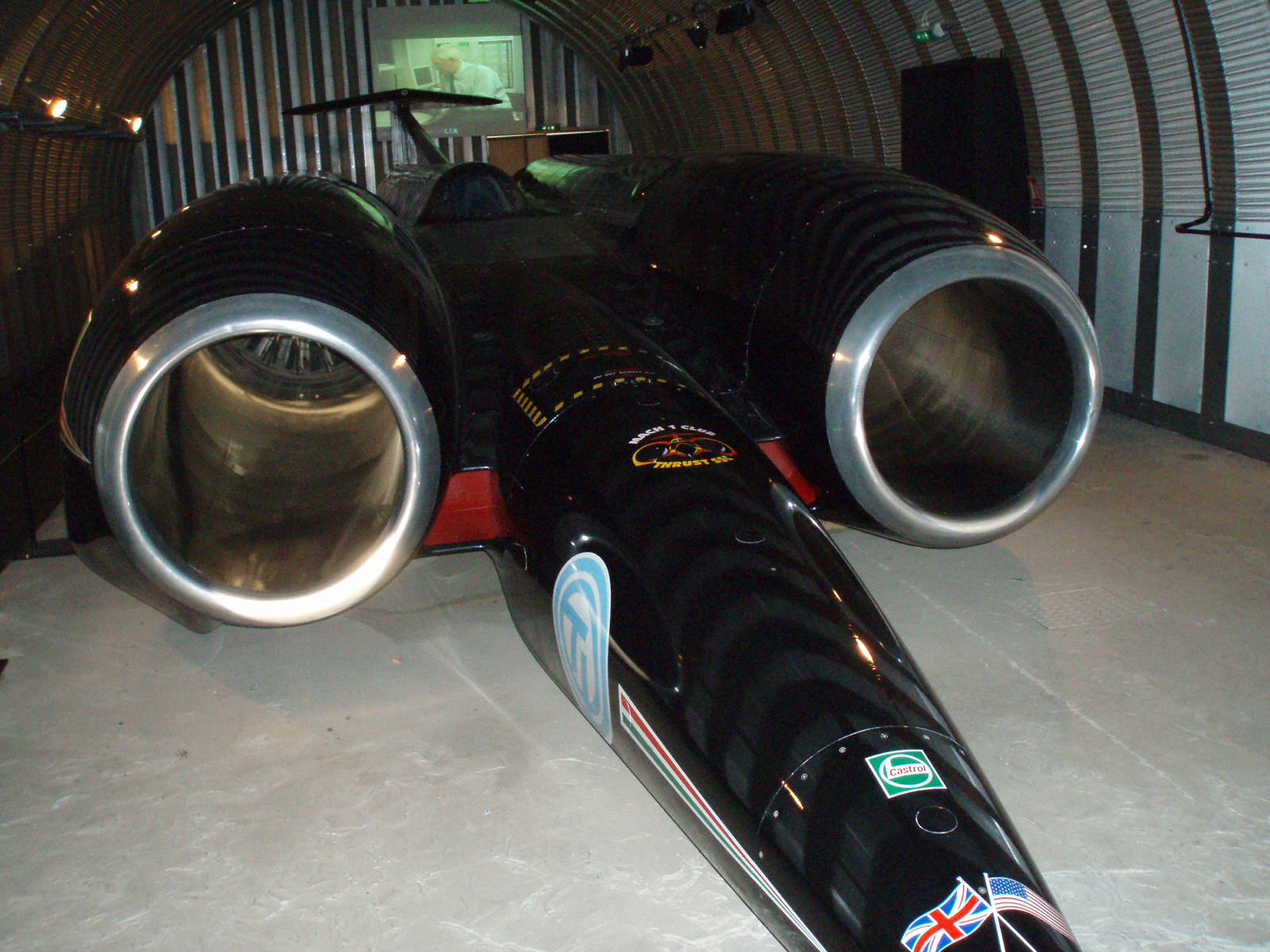
Worlds fastest car: 763.035 mph in 1997
ThrustSSC, driven by Royal Air Force pilot Andy Green, holds the land speed record: 763.035 mph.
Thrust SuperSonic Car in the Black Rock Desert, USA, crossing the measured mile in 1997 with Andy Green at the controls. With a top speed of 763mph Green became the fastest man on the planet - and the first to break the sound barrier on land. He now hopes to smash this record with the 1,000mph Bloodhound SSC ...
The design team palns to test the car on a runway in Britain by the end of 2011 or beginning of 2012. - telegraph
Subscribe to:
Posts (Atom)